
Car Insurance After a Totaled Car: Your Payout, Your Policy and Next Steps
Written by Rakib Sarwar, 15 years in banking and lending · Last updated: October 31, 2026
Why trust this guide: every rule and figure below comes from CarInsurance.com (updated Jul 23 and Jun 26, 2026), The Zebra, Kelley Blue Book (May 2025), Insurify (Jan 2024), PropertyCasualty360 (Dec 2024) or Repairer Driven News (2021), and we name the source each time. We do not sell insurance.
Disclosure: this page may carry ads or links to insurance partners. They do not affect what we write, and we never recommend a policy because of a commission.
Few phone calls feel as final as the one that says your car is a total loss. The car you drove yesterday is gone, a check is coming that may or may not cover a replacement, and the loan, the insurance policy and the clock are all still running.
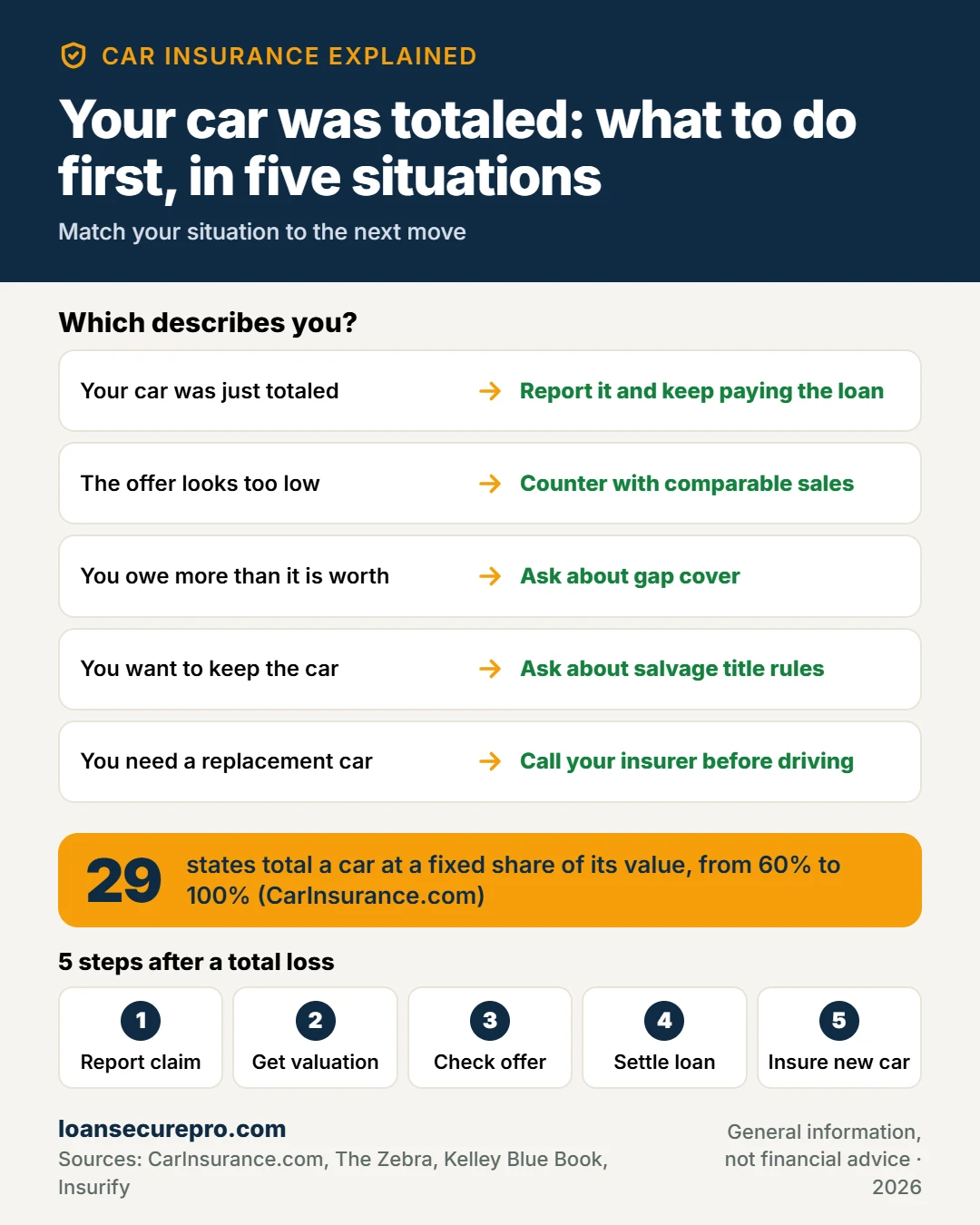
After a total loss, your insurer pays the car’s actual cash value, which is its market value just before the crash, minus your deductible. A car is usually totaled when repair costs reach a state threshold, set between 60 and 100 percent of its value in 29 states, or when repairs exceed its value minus salvage in the other 21. If you owe more than the payout, you still owe the lender unless you have gap cover. You can counter a low offer with comparable sales. Before you drive a replacement, call your insurer, because grace periods for a new car run from about two to 30 days and some insurers give none.
In short: report the claim, keep paying your loan, check the valuation line by line, and sort out coverage for the next car before you collect the keys.
Most pages stop at the definition. The harder questions come afterwards: whether the offer is fair, who pays the loan balance, whether you can keep the car, and how to stay insured without paying twice. A gap in coverage can cost more than the car did.
This guide is for US drivers whose car has been, or may be, declared a total loss. It sets out the state-by-state threshold list, works through payout, gap and salvage examples with real arithmetic, shows where sources disagree, and ends with the steps for insuring your next car.

Key takeaways
- Your insurer pays actual cash value, minus your deductible and any other fees, according to Kelley Blue Book (May 2025).
- Twenty-nine states use a fixed percentage threshold from 60 to 100 percent, and 21 use a total loss formula (CarInsurance.com, Jul 2026).
- The first offer is often lower than expected and can be negotiated, according to The Zebra.
- If you owe $25,000 on a car valued at $20,000, gap cover pays the $5,000 difference (The Zebra example).
- Keep paying the loan during the claim, because missed payments can hurt your credit (Kelley Blue Book).
- Sources disagree on grace periods for a replacement car: 7 to 30 days at CarInsurance.com, 2 to 30 days at Insurify.
- Whether sales tax and fees are added to the payout depends on the state, and courts have ruled both ways.
In this guide
- What “totaled” means
- Total loss thresholds by state
- How the payout is worked out
- Worked examples: thresholds, payout and keeping the car
- If you owe more than the car is worth
- A low offer, or keeping the car
- Insuring your next car without a gap
- What to do, step by step
- Mistakes to avoid
- Where state and insurer rules differ
- Honest limits of this guide
- When to talk to a professional
- Frequently asked questions
What “totaled” means
The Zebra defines a total loss as a vehicle whose repair costs outweigh its value. Kelley Blue Book adds a second trigger: a car can also be totaled when it would still be unsafe to drive after repairs.
The decision is rarely yours. An adjuster inspects the car, a valuation is run, and the repair estimate is compared with a test that depends on your state. Kelley Blue Book says some insurers use a lower threshold than the state requires, because hidden damage often appears once repairs begin.
Which coverage pays depends on who caused the crash. The Zebra sets out three routes:
| What happened | Coverage that pays | Source |
|---|---|---|
| You caused the crash | Your collision coverage | The Zebra |
| Another driver caused it | That driver’s liability coverage | The Zebra |
| Weather, vandalism or similar | Your comprehensive coverage | The Zebra |
If you have no collision or comprehensive coverage and caused the loss, there is nothing to claim on your own car. That is why those coverages matter on any car you could not afford to replace out of savings.
Total loss thresholds by state
CarInsurance.com, updated July 23, 2026, sorts the 50 states into two groups. Twenty-nine use a fixed percentage of the car’s value. The other 21 use a total loss formula, which compares repair cost with the car’s value minus its salvage value.
| Threshold | States |
|---|---|
| 100 percent | Colorado, Texas |
| 80 percent | Florida, Minnesota, Missouri, Oregon |
| 75 percent | Alabama, Kansas, Kentucky, Louisiana, Maryland, Michigan, Nebraska, New Hampshire, New York, North Carolina, North Dakota, Rhode Island, South Carolina, Tennessee, Virginia, West Virginia, Wyoming |
| 70 percent | Arkansas, Indiana, Iowa, Wisconsin |
| 65 percent | Nevada |
| 60 percent | Oklahoma |
| Total loss formula | Alaska, Arizona, California, Connecticut, Delaware, Georgia, Hawaii, Idaho, Illinois, Maine, Massachusetts, Mississippi, Montana, New Jersey, New Mexico, Ohio, Pennsylvania, South Dakota, Utah, Vermont, Washington |
The table counts 2, 4, 17, 4, 1 and 1 states in the percentage group, which adds to 29, plus the 21 formula states. The District of Columbia is not in the list we read.
How the payout is worked out
The payout is the actual cash value, usually shortened to ACV, minus your deductible. The Zebra says the insurer looks at the car’s market value before the accident, including age, mileage, condition, make, model, recent sales of similar cars in your area and depreciation.
Kelley Blue Book notes that most insurers hire a third-party vendor to set the ACV, and that a total loss claim can take up to a month or more to settle. Our guide to how long a car insurance claim takes covers the wider timeline.
| Item | What happens | Source |
|---|---|---|
| Valuation | ACV from market value just before the loss | The Zebra |
| Deductible | Subtracted from the ACV | The Zebra, Kelley Blue Book |
| Owned car | You find the title, remove belongings and hand over the car as the insurer directs | The Zebra |
| Financed or leased car | The check may go to your lender, or to you and the lender | The Zebra |
| Rental | If you have rental coverage, it starts when the adjuster inspects the car | The Zebra |
The Zebra says the first offer is often lower than expected and can be negotiated. Treat it as an opening figure, and check what it is built from before you accept.
Worked examples: thresholds, payout and keeping the car
These examples use the methods the sources describe. Where the dollar figures are ours, we say so.
The same $10,000 car can be totaled at $6,000 of damage in one state and not until $10,000 in another. The method is identical, only the percentage changes.
Under the formula, a car with a high salvage value is totaled sooner, because the salvage value comes off the threshold.
The check is paid first to the lender when the car is financed, so the $13,500 reduces the loan. The remaining $4,500 stays your debt unless gap cover or loan payoff coverage applies.
You are paid the difference between ACV and salvage value, less the deductible, and the car stays with you. That $8,500 has to cover repairs, inspection and any loss of resale value.
If you owe more than the car is worth
A new or financed car often loses value faster than the loan balance falls. When the payout is below the balance, you owe the difference. Kelley Blue Book says the lender is paid from the settlement and you cover any shortfall unless you have gap coverage.
Kelley Blue Book adds that gap coverage may also cover your collision or comprehensive deductible. Ask your insurer and lender whether yours does, and what it excludes. Our guide on what gap insurance is explains the product in more detail.
| Option | What it does | Watch for |
|---|---|---|
| Gap insurance | Covers the difference between the loan balance and the payout | Leases often require it (The Zebra) |
| Loan or lease payoff coverage | Works similarly | Usually capped at a percentage, often up to 25 percent of the car’s value (The Zebra) |
| Neither | You pay the shortfall | Keep making loan payments during the claim (Kelley Blue Book) |
Do not stop paying the loan while the claim is open. Kelley Blue Book warns that missed payments can hurt your credit, and the settlement may take weeks.
A low offer, or keeping the car
You do not have to accept the first valuation. The Zebra advises checking the valuation report for errors in mileage, age and non-standard features, and comparing the value with Kelley Blue Book or NADA. Kelley Blue Book gives a longer path if the insurer will not move.
| Step | What to do | Source |
|---|---|---|
| 1 | Read the valuation report and fix errors in mileage, trim and features | The Zebra |
| 2 | Gather proof of upgrades, new tires and recent repairs | The Zebra |
| 3 | Research prices of comparable vehicles in your market | Kelley Blue Book |
| 4 | Consider an independent appraisal and document the book value at the time of the crash | Kelley Blue Book |
| 5 | Send a counteroffer with the supporting documents | Kelley Blue Book |
| 6 | If the insurer will not move, file a complaint with your state insurance regulator | Kelley Blue Book |
| 7 | As a last resort, speak to an insurance claims attorney | Kelley Blue Book |
Take each step in writing. A valuation based on three comparable cars that sold nearby is far more persuasive than a general complaint that the number feels low.
Should you keep a totaled car?
Depending on state law, you may be able to keep it. Tell your insurer first. The insurer typically deducts the salvage value and your deductible from the fair market value, and you receive what is left. Rules vary by state, so confirm yours.
Kelley Blue Book calls keeping a totaled car generally a bad idea, and says that most of the time you are better off letting the insurer total it. The possible upside is a cheap older car needing mostly cosmetic repairs, or a car kept for parts.
The downsides are repair surprises, a required state inspection, and a salvage or rebuilt title that complicates insurance and resale. The Zebra says the salvage title stays with the vehicle even after repairs, and Kelley Blue Book says some insurers cover rebuilt vehicles for liability only.
Insuring your next car without a gap
Replacing the car is the second half of the problem, and it is where many drivers lose continuous coverage. Do not wait until the payout arrives. Call your insurer while you shop.
Most policies give a short window when you acquire another vehicle. CarInsurance.com (updated June 26, 2026) puts it at typically 7 to 30 days, with some carriers offering only a few days and some none.
Insurify (updated January 26, 2024) puts it at typically 2 to 30 days. The sources disagree on the lower end, so ask your own insurer for the exact figure.
| Situation | What the sources say | Source |
|---|---|---|
| You have an active policy | The new car may get the same coverage type and limits as your current policy | CarInsurance.com |
| Your policy lacks full coverage | Full coverage applies only if your existing policy already includes it | CarInsurance.com |
| You have no active policy | There is no grace period, so you need a policy before driving | CarInsurance.com, Insurify |
| A lender or lease applies | The lender may require full coverage before you take possession | CarInsurance.com |
| Buying at a dealership | Show proof of insurance before leaving the lot | Insurify |
| Buying from a private seller | Complete the purchase under your existing policy, or buy new coverage before driving away | Insurify |
Insurify says the same window usually applies whether the car is new or used and whether you are adding a vehicle or replacing one, and that your current policy typically covers the new car during it. Add the car as soon as you can, and ask how your premium will change.
While you shop, compare at least three quotes for the replacement car and ask each insurer about gap cover if you are financing again. The same policy that protected you before will not always be the cheapest for the next car.
What to do, step by step
- Report the claim. Tell your insurer, or the at-fault driver’s insurer, as soon as it is safe, and ask which coverage will pay.
- Keep paying the loan. Continue payments until the lender confirms the payoff, because missed payments can hurt your credit.
- Collect your records. Gather the title or loan details, photos, service receipts and a list of upgrades and recent repairs.
- Get the valuation in writing. Ask for the full valuation report, with the comparable cars used, the mileage and the condition assumed.
- Check it against other sources. Compare with Kelley Blue Book or NADA values and with listings for similar cars near you.
- Respond with evidence. If the offer is low, send a written counteroffer with documents, and escalate in the order shown above if needed.
- Settle the loan and remove belongings. Clear personal items, hand over the car as directed, and confirm what the lender received.
- Insure the replacement before driving. Call your insurer with the new car’s VIN, make and model, and confirm coverage in writing.
Information to have ready: your claim number, the title or lienholder details, the loan balance, your policy number, the VIN of the old car, and photos of the damage and the car’s condition before the crash.

Mistakes to avoid
These errors cost people the most after a total loss, because each one is hard to undo once the claim is closed.
Accepting the first offer without reading the report. The Zebra says the first offer is often lower than expected, and valuation errors in mileage or features are a common reason.
Stopping loan payments. The lender is still owed, and Kelley Blue Book warns of credit damage.
Assuming the payout covers the loan. If you owe more than the ACV, the shortfall is yours without gap or payoff coverage.
Driving a replacement before confirming coverage. A grace period may be short, absent, or limited to the coverage you already carry.
Do
- Ask for the valuation report in writing
- Counter with comparable sales and receipts
- Keep paying the loan during the claim
- Confirm gap or payoff coverage
- Call your insurer before driving a replacement
Don’t
- Accept the first figure without checking it
- Stop paying the lender
- Cancel your policy before the new car is covered
- Keep the car without asking about a salvage title
- Assume sales tax and fees are included
Where state and insurer rules differ
Four things vary: the threshold test, whether taxes and fees are added to the payout, whether you may keep the car, and how long a new-car grace period lasts.
Thresholds. The state list above shows 29 percentage states and 21 formula states. An insurer may apply a lower threshold than the state minimum, according to Kelley Blue Book.
Sales tax and fees. The answer is state-specific. Under Colorado statute C.R.S. 10-4-639, insurers must pay title fees, sales tax and other transfer or registration fees after a total loss, according to PropertyCasualty360 (Dec 2024).
Colorado’s Division of Insurance limited “registration fees” to weight-based passenger-vehicle fees of $2 to $20.
Other courts have gone the other way. Repairer Driven News (Jul 2021) reports a Massachusetts Superior Court ruling that an insurer correctly left titling, registration and inspection costs out of ACV, which plaintiffs appealed.
It also reports a 2020 Fifth Circuit ruling that Texas law did not require an insurer to pay sales tax and mandatory transfer fees. Ask your insurer in writing what it adds.
Keeping the car. Rules vary by state, and salvage and rebuilt titles are handled differently in each. Confirm with your insurer and your motor vehicle agency before you decide.
Honest limits of this guide
This guide cannot tell you what your insurer will pay. The threshold list comes from CarInsurance.com as updated on July 23, 2026, and state rules change. We did not check each state’s statute or contact any insurer.
The sources describe the threshold test in slightly different words, and they disagree on the length of the new-car grace period, which is why we show both ranges. Examples 3 and 4 use assumed dollar figures to show the method, and Examples 1, 2 and 5 are the sources’ own examples.
The tax and fee rulings are from one Colorado bulletin, a Massachusetts trial court that was under appeal, and one Fifth Circuit ruling. They do not settle the question for your state. Verify what applies to your claim.
When to talk to a professional
A licensed agent can tell you how your policy treats total losses, whether you have gap or payoff coverage, and how long your new-car grace period lasts. Ask these questions before you need them, not during a claim.
If you disagree with a valuation and the insurer will not move, file a complaint with your state insurance department. For a dispute about what your policy promised, or if you are considering legal action, speak to a licensed attorney in your state. Your lender can confirm the payoff figure and what it has received.
Disclaimer: this article is general information, not insurance, legal or financial advice. Coverage and rules depend on your policy, your state and your insurer. Confirm details with a licensed professional before relying on them.
Frequently asked questions
When is a car considered totaled?
When repair costs outweigh its value, according to The Zebra. States use either a fixed percentage of the car’s value, from 60 to 100 percent in 29 states, or a formula that subtracts salvage value, used in 21. Kelley Blue Book adds that an unsafe-after-repair car can also be totaled.
How much will insurance pay for a totaled car?
Actual cash value, minus your deductible and any other fees, according to Kelley Blue Book. Actual cash value is the car’s market value just before the loss, based on age, mileage, condition and local sales of similar cars. The first offer can often be negotiated.
Does insurance pay off the loan on a totaled car?
Only up to the payout. The insurer pays your lender from the settlement, and if the amount is below your balance, you owe the difference unless gap coverage applies. In The Zebra’s example, a $25,000 loan on a $20,000 car leaves $5,000 that gap insurance covers.
Can I negotiate a total loss offer?
Yes. The Zebra says the first offer is often lower than expected and can be negotiated. Check the report for errors, document upgrades, and send comparable sales. If the insurer will not move, Kelley Blue Book suggests an appraisal, a counteroffer, then a complaint to your state regulator.
Can I keep my car if it is totaled?
Often, depending on state law. The insurer typically deducts salvage value and your deductible from fair market value and pays you the rest. A salvage title is issued and stays with the car after repairs, per The Zebra. Kelley Blue Book calls keeping it generally a bad idea.
Do I keep paying my loan after the car is totaled?
Yes, until the lender confirms the payoff. You still owe the lender after a total loss, and Kelley Blue Book warns that missed payments can hurt your credit. The settlement can take up to a month or more, so keep payments current while the claim is open.
Will the insurer pay sales tax and fees on my totaled car?
It depends on the state. Colorado statute requires insurers to pay title fees, sales tax and some transfer or registration fees, per PropertyCasualty360. A Massachusetts trial court and the Fifth Circuit, for Texas, ruled insurers need not include them. Ask your insurer in writing.
How long do I have to insure a replacement car?
CarInsurance.com says typically 7 to 30 days, and Insurify says typically 2 to 30 days. Some insurers give only a few days, and some give none. With no active policy there is no grace period. Call your insurer before you drive the new car.
Will my current policy cover the new car automatically?
Often, for a short time. CarInsurance.com says the new car may receive the same coverage type and limits as your current policy, and full coverage applies only if the policy already includes it. Insurify says your policy typically covers a replacement during the grace period. Confirm with your insurer.
Does gap insurance cover my deductible?
Sometimes. Kelley Blue Book says gap coverage may also cover your collision or comprehensive deductible, so the wording matters. Read the policy, ask your insurer or lender, and compare it with loan or lease payoff coverage, which The Zebra says is often capped at 25 percent of the car’s value.
The bottom line
A total loss ends with a check, but the check is only the start. The valuation, the loan balance and the replacement car each need a decision, and each one is easier to handle with the facts in hand.
Today, report the claim, keep paying your loan, and ask your insurer for the valuation report in writing. This week, check it against comparable sales and call your agent about gap cover and the grace period for your next car.
Sources
- CarInsurance.com: Total loss thresholds by state (updated Jul 23, 2026) (accessed Oct 31, 2026)
- The Zebra: Total loss car insurance (accessed Oct 31, 2026)
- Kelley Blue Book: Quick facts about totaled cars (May 22, 2025) (accessed Oct 31, 2026)
- CarInsurance.com: New car insurance grace period (updated Jun 26, 2026) (accessed Oct 31, 2026)
- Insurify: Car insurance grace period when you buy a car (updated Jan 26, 2024) (accessed Oct 31, 2026)
- PropertyCasualty360: Colorado clarifies insurer responsibility for registration fees after total loss (Dec 13, 2024) (accessed Oct 31, 2026)
- Repairer Driven News: Total losses, ACV and state charges (Jul 5, 2021) (accessed Oct 31, 2026)