Car Insurance for Luxury Vehicles: What It Costs and What to Cover
Written by Rakib Sarwar, 15 years in banking and lending · Last updated: October 31, 2026
Why trust this guide: every price and rule below comes from Insurify (Oct 29, 2026), Compare.com (2026), The Zebra (2026), ValuePenguin (Sep 11, 2025) or Kiplinger (updated Jun 2, 2026), and we name the source each time. We do not sell insurance.
Disclosure: this page may carry ads or links to insurance partners. They do not affect what we write, and we never recommend a policy because of a commission.
A luxury car changes more than your monthly payment. It changes how insurers price repairs, theft and total losses, and it raises the stakes on policy terms most drivers never read. Many owners carry over the policy from their last car and find the gaps only after a claim.
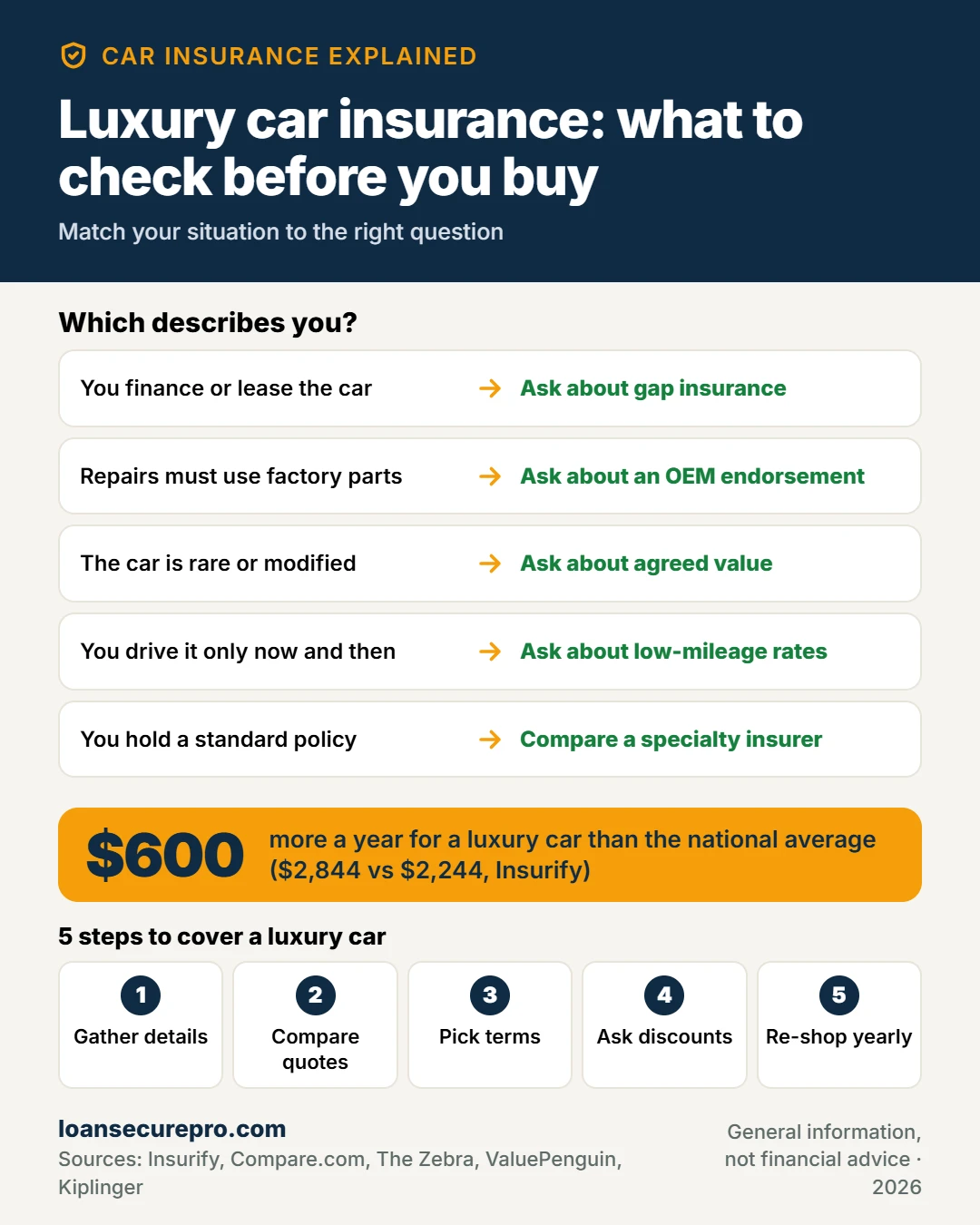
Yes, car insurance for luxury vehicles usually costs more, but how much depends on whose data you read. Insurify’s October 2026 figures put luxury cars at about $2,844 a year for full coverage, roughly 27 percent above the $2,244 national average. Compare.com shows a smaller gap, $167 a month against $146 for all vehicles, or about 14 percent. Performance models cost far more: The Zebra lists $7,819 a year for a BMW M5. Beyond price, check agreed value, original-parts repairs and gap cover, and compare a specialty insurer if the car is rare or modified.
In short: expect to pay more than the average driver, compare at least three insurers on identical terms, and check four things before you buy: agreed value, OEM parts, gap cover and the repair-shop rules.
Price is only half the picture. A cheaper policy that settles at depreciated market value, or repairs your car with parts you did not expect, can cost thousands more after a claim than a mid-priced policy with the right terms.
This guide is for US drivers who own, lease or plan to buy a luxury car. It puts four published price studies side by side and shows where they disagree, works through three costly examples with real figures, and lists every saving tactic with its trade-off.

Key takeaways
- Insurify puts luxury full coverage at about $2,844 a year, 27 percent above the $2,244 national average (Oct 2026).
- Compare.com shows a smaller gap: $167 a month for luxury cars against $146 for all vehicles, about 14 percent.
- Model matters more than badge: The Zebra lists $7,819 a year for a BMW M5, and Compare.com lists $6,380 for a BMW M4.
- Insurer choice moves the price by hundreds of dollars: Insurify’s cheapest average is USAA at $112 a month, against $168 at Progressive.
- Agreed value, OEM parts and gap cover change what you receive after a claim, not only the premium.
- ValuePenguin says OEM-parts endorsements are a paid add-on, often limited to cars about seven to 10 years old.
- Rare, modified or collector cars may need a specialty insurer, according to Kiplinger.
In this guide
- Why luxury cars cost more to insure
- What luxury car insurance costs
- Coverage that matters on a luxury car
- Worked examples: parts, total loss and shopping
- Standard insurer or specialty insurer?
- Ways to lower the bill, with trade-offs
- How to insure a luxury car, step by step
- Mistakes to avoid
- Where state and insurer rules differ
- Honest limits of this guide
- When to talk to a professional
- Frequently asked questions
Why luxury cars cost more to insure
Insurers price a car on what it costs to fix, replace and steal, plus how it is driven. Luxury cars score high on the first three, and the sources we read agree on the main reasons.
| Cost driver | What it means for your premium | Source |
|---|---|---|
| Premium parts | High repair and replacement costs for original-quality parts | The Zebra |
| Technology | Advanced technology and proprietary systems need specialised labour | The Zebra, Compare.com |
| Performance | Larger engines and more horsepower can mean higher accident risk | Kiplinger, The Zebra |
| Theft and claims | Claim and theft frequency are priced into the rate | The Zebra |
| Rarity | Small production runs make a totalled car costly to replace | Kiplinger |
| Customisation | Modifications raise both the car’s value and the repair bill | Kiplinger |
Your own profile still matters. The Zebra adds that driver profile, location and coverage choices shape the final rate, so two owners of the same car can pay very different amounts.
What luxury car insurance costs
No single number is right. The studies below use different data, definitions and coverage assumptions, and the pages we read do not share one set of terms. Treat the gap as a range, not a fact.
| Source | Luxury cars | Comparison | Gap |
|---|---|---|---|
| Insurify (quotes from the 10 days before Oct 29, 2026) | $237 a month, about $2,844 a year | $187 a month, about $2,244 a year (US average) | About 27 percent |
| Compare.com (page dated Oct 29, 2026) | $167 a month | $146 a month (all vehicles) | About 14 percent |
| Compare.com, new models (Jul 2026) | Not a luxury average | New 2025/2026 models $2,879 a year against $2,144 for all vehicles | About 34 percent for new cars |
| The Zebra (2026) | BMW M5 at $7,819 a year | The Zebra puts the M5 about 260 percent above the national average | Model-level only |
Insurify publishes monthly figures, so we multiplied by 12 for the annual numbers. The takeaway is that a typical luxury car costs hundreds of dollars more a year, and a performance model costs several times the average.
Most expensive models in two studies
The two model lists measure different things. The Zebra uses a sample profile built from rate filings. Compare.com uses two-year median rates for drivers aged 20 to 70, with state-minimum liability and a $1,000 deductible on comprehensive and collision.
| Rank | The Zebra (2026, annual) | Compare.com (Jul 2026, annual) |
|---|---|---|
| 1 | BMW M5: $7,819 | BMW M4: $6,380 |
| 2 | Audi S8: $7,069 | Cadillac CT4-V: $5,542 |
| 3 | Audi RS 7: $7,065 | Mercedes-Benz G-Class: $5,501 |
| 4 | Mercedes-Benz S-Class: $6,574 | Audi S5: $4,937 |
| 5 | Mercedes-Benz SL-Class: $6,364 | BMW i5: $4,920 |
Only the Mercedes-Benz G-Class lines up closely: The Zebra lists $5,623 and Compare.com $5,501. The AMG GT does not, at $6,073 in The Zebra and $4,713 in Compare.com. Model rankings are a guide, not a quote.
Exotic and electric examples from Insurify
| Vehicle | Full coverage, per month | About per year |
|---|---|---|
| Ferrari | $601 | $7,210 |
| Lamborghini | $516 | $6,190 |
| Tesla Model Y | $288 | $3,460 |
| Toyota Camry (comparison) | $157 | $1,880 |
The cheapest insurer for luxury drivers varies by study, as the next table shows. Both lists put GEICO and State Farm near the bottom of the price range and Progressive higher.
| Insurer | Insurify (per month) | Compare.com (per month) |
|---|---|---|
| USAA | $112 | Not listed |
| State Farm | $125 | $133 |
| GEICO | $130 | $132 |
| Allstate | $154 | $148 |
| Progressive | $168 | $172 |
| American Family | Not listed | $173 |
Coverage that matters on a luxury car
The basic coverages are the same as for any car. What changes is how much each term is worth when the car is expensive, rare or financed.
| Coverage or term | What it does | Why it matters on a luxury car |
|---|---|---|
| Liability | Pays for injury and damage you cause to others | Compare.com lists higher liability limits as an add-on for luxury owners |
| Collision and comprehensive | Pay to repair or replace your own car after a crash or non-crash loss | Compare.com’s model study assumes a $1,000 deductible on both |
| Agreed value | You and the insurer set the car’s value in advance | Insurify says exotic cars often hold or gain value instead of depreciating |
| OEM parts endorsement | Requires original-manufacturer parts in repairs | Usually a paid add-on with age limits on the car (see below) |
| Gap insurance | Pays the difference if you owe more than the insurer pays | Insurify says it covers the difference on a financed or leased car |
| Insurer extras | New-car replacement, accident forgiveness, diminished value, rental and roadside | Compare.com says these vary by insurer, so ask for them by name |
Agreed value is the term most often missed. Under standard terms, a total loss is usually settled at the car’s actual cash value, which is its market value on the day of the loss. Insurify says agreed value can protect you better because the amount is set up front. Ask what documents the insurer needs.
ValuePenguin describes OEM coverage as a paid add-on. It names American Family, Farmers and Liberty Mutual as insurers that offer it, says you generally need full coverage, and notes it is often limited to cars about seven to 10 years old and added through an agent.
Read what the policy promises before you pay for extras. Our guide on what gap insurance is explains the shortfall it covers, and our guide on how car insurance deductibles work shows how the deductible changes your risk.
Worked examples: parts, total loss and shopping
These examples use published figures where we have them and assumed figures where we say so. They show how much one policy term can change the result.
ValuePenguin’s example is a Honda part, not a luxury one, and we found no published luxury-specific parts figure. Luxury parts are likely to cost at least as much, but treat that as an expectation, not a fact. ValuePenguin also says insurers are not obliged to pay for OEM parts just because you prefer them.
The figures are assumed, but the shape is real: a new luxury car can lose value faster than the loan balance falls, which is exactly the gap Insurify says this cover addresses.
USAA is open only to eligible military members and their families, so that quote is not available to everyone. Even so, the GEICO and American Family spread shows that comparing quotes can be worth several hundred dollars a year.
Standard insurer or specialty insurer?
Kiplinger says standard insurers often cover luxury cars, but exotic cars, meaning rare, high-performance or limited-production models, usually need policies from niche specialty providers. It adds that regular insurers who do cover exotics often charge much higher premiums than specialty insurers.
| Your car | Where to start | Why |
|---|---|---|
| Mainstream luxury sedan or SUV | Standard insurers, three quotes | Covered by many standard policies; compare identical terms |
| Rare, limited-production or high-performance | At least one specialty insurer | Standard insurers may charge much more or decline |
| Heavily customised | Specialty insurer, with documentation | Modifications raise value and repair cost |
| Several high-end cars | Ask about separate policies | Kiplinger says a collection may need more than one policy |
| Car you show at events | Specialty insurer | Insurify says they are more likely to cover show events |
Ways to lower the bill, with trade-offs
Every saving tactic shifts some cost or risk back to you. The table shows what you give up for each one, based on Kiplinger, The Zebra and Compare.com.
| Tactic | What it does | Trade-off |
|---|---|---|
| Compare quotes | Insurer spreads run to hundreds of dollars a year | Takes an hour or two |
| Ask about low mileage | Helps if you drive the car only occasionally | Mileage limits apply |
| Bundle with home | Multi-policy discounts | Ties you to one insurer |
| Add theft and safety devices | GPS tracking, alarms and driver-assistance features can earn discounts | Equipment costs money |
| Telematics program | Prices driving behaviour | Rates can rise if you drive riskily |
| Raise the deductible | Lowers the premium | You pay more out of pocket on a claim |
| Remove non-drivers | Drops household members who never drive the car | They are not covered if they do |
| Buy a slightly older model | The Zebra says older luxury cars are usually cheaper to insure | Fewer new features |
Compare.com found new 2025/2026 models cost $2,879 a year on average against $2,144 for all vehicles, so model year matters too. Our guide on how to lower your car insurance premium covers the wider list of levers.
Kiplinger also advises reviewing the policy every year and dropping add-ons you do not need. Raise the deductible only if you have savings to cover it after a claim.
How to insure a luxury car, step by step
- Gather the car details. Collect the make, model, year, trim and VIN, photos of the engine and interior, a list of modifications and your loan balance.
- Ask your lender what it requires. Financed and leased cars usually come with coverage rules, so confirm them before you shop.
- Choose limits and a deductible. Pick liability limits that protect what you own, and a deductible you could pay within days.
- Decide on the extra terms. Weigh agreed value, an OEM endorsement and gap cover against their cost.
- Get at least three quotes. Use identical limits and terms, and add a specialty insurer if the car is rare or modified.
- Ask about discounts. Request low-mileage, bundling, theft-device and safe-driver discounts by name.
- Read the repair rules. Check how the policy treats parts, repair shops and total-loss settlements before you sign.
- Re-shop at every renewal. Compare again each year and after any change in value, mileage or modifications.
Information to have ready: driver’s licences for everyone who drives the car, the VIN, the purchase price or appraisal, the loan or lease details, and your current policy.
Mistakes to avoid
These errors cost luxury owners the most, because each one can turn a large claim into a large dispute.
Assuming the policy pays what you paid. Standard terms settle a total loss at market value on the day of the loss, which can be well below your purchase price.
Assuming original parts are included. Insurers may use aftermarket parts in estimates, and an OEM endorsement is a separate add-on that many insurers do not offer.
Comparing quotes with different terms. A lower price often reflects a higher deductible or lower limits, so compare like for like.
Hiding modifications or a second driver. Undisclosed changes can cause trouble at claim time, so declare them up front.
Do
- Compare three or more insurers
- Match limits and deductibles
- Document the car with photos
- Ask about agreed value and gap
- Re-shop every renewal
Don’t
- Assume the purchase price is covered
- Assume factory parts are included
- Pick the lowest quote without reading terms
- Hide modifications
- Raise the deductible past what you can pay
Where state and insurer rules differ
Three things vary: what insurers charge, what each insurer offers, and what your state requires about repair parts.
Parts rules. ValuePenguin says most states do not require insurers to use OEM parts after a crash, and a handful require them for newer vehicles. Insurers generally must say on the estimate when they plan to use aftermarket parts. In New York, Oregon and Rhode Island, you must agree to aftermarket parts before repairs begin.
Insurer offerings. OEM endorsements, agreed value and accident forgiveness differ by company, and some do not sell them at all. Ask each insurer what it offers for your car and which age limits apply.
Prices. The studies above are national or sample-based. Your state, ZIP code, record and credit history, where allowed, change the price, so a quote in your ZIP code is the only reliable number.
Honest limits of this guide
This guide cannot tell you what you will pay. The prices come from studies published between September 2025 and October 2026, and rates move.
The sources disagree, and we cannot fully reconcile them. Insurify shows a 27 percent luxury premium, Compare.com about 14 percent, and the model rankings differ. The pages we read do not publish matching assumptions, and Insurify’s annual figures are our conversions from monthly numbers.
Example 1 uses a Honda part, Examples 2 and 3 mix assumed and published figures, and we did not contact any insurer or request quotes. ValuePenguin’s OEM details come from one article, so confirm them with your insurer.
When to talk to a professional
A licensed independent agent or broker can quote standard and specialty insurers side by side and explain which terms apply to your car. Tell them the car’s value, modifications, loan balance and how often you drive it.
If a total-loss settlement seems too low, ask the insurer for its valuation in writing and contact your state insurance department. For a dispute over what a policy promised, speak with a licensed attorney in your state.
Disclaimer: this article is general information, not insurance, legal or financial advice. Coverage and prices depend on your policy, your state and your insurer. Confirm details with a licensed professional before relying on them.
Frequently asked questions
Does a luxury car cost more to insure?
Usually, yes. Insurify puts luxury full coverage about 27 percent above the national average, and Compare.com shows about 14 percent. Higher repair costs, specialised labour and theft risk drive the difference. Your own price still depends on the model, your record and where you live.
How much does luxury car insurance cost per month?
Insurify’s October 2026 average is $237 a month for full coverage, against $187 nationally. Compare.com shows $167 for luxury cars against $146 for all vehicles. The studies use different data, so expect a range. A performance model can cost several times the average.
What are the most expensive luxury cars to insure?
The Zebra’s 2026 list is led by the BMW M5 at $7,819 a year, then the Audi S8 and Audi RS 7. Compare.com’s July 2026 list is led by the BMW M4 at $6,380. Rankings differ by study, so get a quote for your own model.
Who has the cheapest insurance for luxury cars?
It depends on the study. Insurify’s lowest average is USAA at $112 a month, then State Farm at $125 and GEICO at $130. Compare.com’s lowest are GEICO at $132 and State Farm at $133. Your own quote can differ, so compare at least three insurers.
What is agreed value coverage?
It means you and the insurer set the car’s value in advance, and that value is used for the rate and the coverage amount. Insurify says it can protect owners of cars that hold or gain value. Ask what documents the insurer needs to confirm the value.
Do I need an OEM parts endorsement?
Only if you want original-manufacturer parts in every repair. ValuePenguin says it is a paid add-on, offered by some insurers, often limited to cars about seven to 10 years old. Without it, the estimate may use aftermarket parts, and you may pay any difference if you insist on original ones.
Do I need gap insurance on a financed or leased luxury car?
It is worth pricing. Insurify says gap cover pays the difference if you owe more than the insurer pays after a total loss. In our assumed example, the shortfall was $8,000. Ask your lender what it requires, and ask whether gap also covers your deductible.
Do I need a specialty insurer?
Not for most luxury sedans and SUVs, which many standard insurers cover. Kiplinger says exotic, rare or limited-production cars usually need a niche specialty insurer, and standard insurers that do cover them often charge much more. Get one specialty quote if your car is rare or modified.
Are older luxury cars cheaper to insure?
Usually. The Zebra says older luxury cars are usually cheaper to insure than new ones, though still costly. Compare.com found new 2025 and 2026 models average $2,879 a year, against $2,144 for all vehicles. Model year is one of the few levers you control before buying.
Are electric luxury cars more expensive to insure?
Often, but the sources do not isolate the effect. Insurify lists the Tesla Model Y at $288 a month against $157 for a Toyota Camry. The Zebra lists the Lucid Air at $6,040 a year, and Compare.com lists the BMW i5 at $4,920. Get a quote for your model.
The bottom line
Luxury car insurance costs more, but how much more depends on the model, the insurer and the terms. The price study you read matters less than the quote for your own car, and the policy terms matter as much as the premium.
This week, gather your car’s details, request three quotes on identical terms, and ask each insurer about agreed value, OEM parts and gap cover. Add one specialty quote if the car is rare or modified, then set a reminder to compare again before renewal.
Sources
- Insurify: Luxury and exotic car insurance (updated Oct 29, 2026) (accessed Oct 31, 2026)
- Compare.com: Best car insurance companies for luxury cars (page dated Oct 29, 2026) (accessed Oct 31, 2026)
- Compare.com: Most expensive 2025/2026 models to insure (Jul 14, 2026) (accessed Oct 31, 2026)
- The Zebra: The most expensive vehicles to insure in 2026 (accessed Oct 31, 2026)
- ValuePenguin: OEM vs. aftermarket car parts (Sep 11, 2025) (accessed Oct 31, 2026)
- Kiplinger: Luxury, exotic and classic car insurance (updated Jun 2, 2026) (accessed Oct 31, 2026)