
How Car Insurance Deductibles Work: How to Pick the Right Amount
Written by Rakib Sarwar, 15 years in banking and lending · Last updated: October 31, 2026
Why trust this guide: every rule and figure below comes from the Insurance Information Institute, the NAIC or ISO claim statistics, with the year stated. We do not sell insurance.
Disclosure: this page may carry ads or links to insurance partners. They do not affect what we write, and we never recommend a policy because of a commission.
You are staring at two quotes for the same car. One has a $500 deductible and the other has $1,000, and the second is cheaper. It is tempting to take the lower price, but that choice also decides how much cash you must find on the worst day of your year.
A car insurance deductible is the amount you pay toward a covered repair before your insurer pays the rest. It applies per claim, mainly to collision and comprehensive coverage, and you choose the amount when you buy the policy. If your deductible is $500 and a covered repair costs $3,000, you pay $500 and the insurer pays $2,500. A higher deductible usually lowers your premium because you carry more of each loss. A lower deductible raises the premium but reduces the cash you need at claim time. Liability coverage has no deductible.
In short: pick the highest deductible you could pay from savings without strain, then check the premium saving against the added risk using the break-even math below.
Industry data helps size that risk. ISO figures published by the Insurance Information Institute show 4.16 collision claims and 3.95 comprehensive claims per 100 car years in 2024. The ISO table is based on coverage with a $500 deductible.
This guide is for US drivers choosing or changing a deductible. It covers which coverages have one, a worked payout example, break-even and decision tables, what happens when someone else is at fault, and where state and lender rules differ.

Key takeaways
- A deductible is the share of a covered loss you pay first, per claim, on collision and comprehensive.
- Liability coverage has no deductible, because it pays other people and not your car.
- Raising a deductible lowers the premium, but you absorb more of every claim and every small repair.
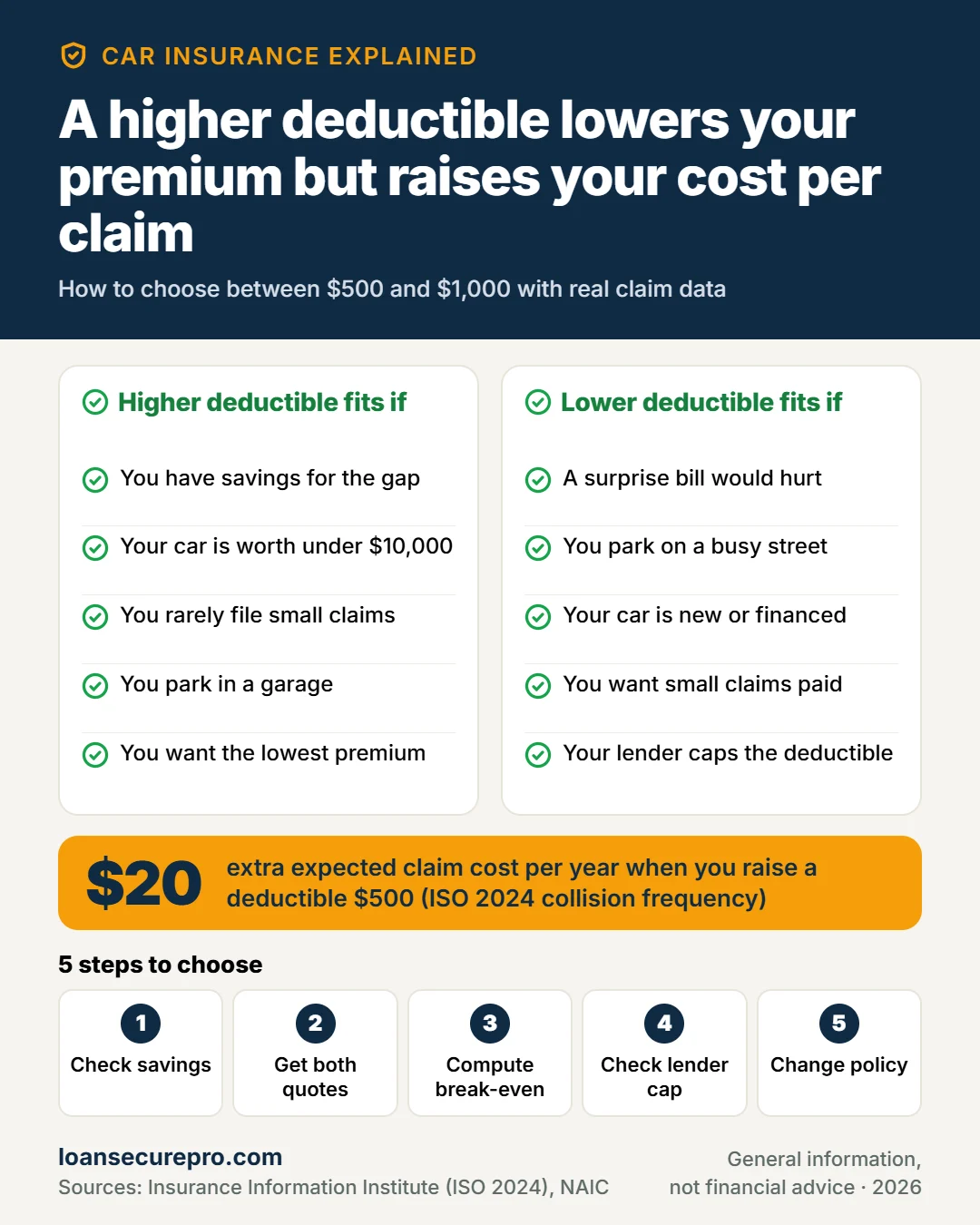
- With ISO’s 2024 claim rates, raising a deductible by $500 costs roughly $20 a year in expected claims.
- If the premium saving is clearly above that, and you have savings, the higher deductible usually wins.
- If another driver is at fault and your insurer recovers the money, you may get your deductible back.
- Your lender can cap the deductible you are allowed to choose on a financed or leased car.
In this guide
- What is a car insurance deductible?
- Which coverages have a deductible?
- How a deductible works: a worked example
- Higher or lower? The break-even math
- Which deductible fits your situation?
- What if the other driver is at fault?
- How to choose and change your deductible, step by step
- Do and don’t when choosing
- Where state and lender rules differ
- Honest limits of this guide
- When to talk to a professional
- Frequently asked questions
What is a car insurance deductible?
A deductible is the part of a covered loss that you pay yourself. The Insurance Information Institute notes that collision and comprehensive are generally sold with their own, separate deductibles. You pick the amounts when you buy the policy, and they stay fixed until you change them.
NerdWallet’s guide says deductibles commonly range from $100 to $2,000, and that $500 is the most common choice. That is a description of the market, not advice for your situation.
Two points trip people up. First, the deductible applies to each claim, not to the year. Second, it comes out of the settlement, so the check you receive is the repair cost minus the deductible.
Which coverages have a deductible?
Not every part of a policy has one. The table shows where you will and will not see a deductible, so you know which numbers on your declarations page matter.
| Coverage | Has a deductible? | What it affects |
|---|---|---|
| Liability (injury and property damage) | No | Pays other people, so there is nothing for you to share |
| Collision | Yes | Crashes with vehicles or objects, potholes and rollovers |
| Comprehensive | Yes, usually separate from collision | Theft, vandalism, weather, fire, animals and glass; see what comprehensive car insurance covers |
| Uninsured motorist property damage | Varies by state and insurer | Damage caused by an uninsured or hit-and-run driver |
| Personal injury protection or med pay | Varies | Medical costs, in states and policies that include it |
| Glass add-on | Often reduced or zero | Windshield and window repair |
Look at your declarations page for the line items, usually labeled “ded.” beside collision and comprehensive. Many drivers set them at the same amount, but they can differ. A lower comprehensive deductible is common for people who park on the street.
How a deductible works: a worked example
The settlement is the repair cost, or the car’s actual cash value if it is a total loss, minus your deductible. Here are three outcomes at the same $500 deductible.
The second case is the one people forget. A deductible means small damage is effectively uninsured, which is why a high deductible suits drivers who would pay small repairs themselves anyway.
The numbers here are placeholders for the method, not predictions. Your own estimate and policy will differ.

Higher or lower? The break-even math
Insurers lower the premium when you raise the deductible because you are taking on more of each loss. The question is whether the discount is bigger than the extra expected cost. Two simple calculations answer it.
Step 1: expected extra cost per year. Multiply the claim rate by the extra deductible. ISO’s 2024 data, published by the Insurance Information Institute, gives 4.16 collision claims per 100 car years. That is about 4.2 percent a year.
Step 2: break-even years. Divide the extra deductible by the annual premium saving. This tells you how long the discount takes to cover one extra deductible payment.
On these assumptions, the higher deductible wins on average. But the average hides the bad year: when the claim comes, you need the extra $500 in cash. If the premium saving were only $10 a year, the expected cost of $21 would beat it, and the lower deductible would be the better value.
The 4.16 rate is an industry average. If you have made several claims, park on a busy street or drive a lot, your own rate may be higher.
Which deductible fits your situation?
The right amount is a mix of math and cash. Use the table to see which side of each question you are on.
| Your situation | Leans toward | Why |
|---|---|---|
| You have savings that would cover $1,000 or more without strain | Higher deductible | You can absorb the larger bill, and the discount is yours to keep |
| A $1,000 repair bill would force you onto a credit card | Lower deductible | A lower premium is not worth a financial emergency |
| Older car, value under about $5,000 | Higher, or consider dropping collision | The maximum payout is small relative to premium |
| New or financed car | Check your lender’s cap first | The loan agreement may require a maximum deductible |
| You park outdoors in a hail or theft-prone area | Lower comprehensive deductible | Comprehensive claims are more likely where you live |
| You park in a garage and have a clean record | Higher deductible | Lower claim risk makes the extra deductible cost less likely |
| You would claim for small dents and scrapes | Lower deductible | A high deductible turns small repairs into your own cost |
A useful rule: choose the highest deductible whose full amount you could pay this week from savings. That keeps the premium discount without turning a claim into a crisis.
What if the other driver is at fault?
If another driver caused the crash, you can often get your deductible back. The Insurance Information Institute explains that your insurer may pay your claim, then try to recover its payment from the other driver’s insurer. If it succeeds, you are reimbursed the deductible too.
This process is called subrogation. It can take weeks or months, and it only works when fault is clear and the other driver has coverage.
You can also claim directly against the at-fault driver’s liability insurer, which pays without your deductible. That route is slower and depends on the other insurer accepting fault.
How to choose and change your deductible, step by step
You can change deductibles at renewal, and many insurers let you change them mid-term with a prorated premium. Work through these steps before you call.
- Find your current deductibles. Check the declarations page for collision, comprehensive and any glass or uninsured motorist deductible.
- Check your savings. Decide the largest deductible you could pay this week without borrowing.
- Read your loan or lease terms. Find the maximum deductible your lender allows, if any.
- Get quotes at two or three levels. Ask for $500, $1,000 and possibly $250 or $2,000, with the same limits and coverages.
- Run the break-even math. Subtract the expected extra cost from the premium saving, using the formula above.
- Consider the two coverages separately. You may choose a higher collision deductible but a lower comprehensive one, or the reverse.
- Make the change in writing. Ask for a revised declarations page and confirm the effective date.
- Set a yearly reminder. Review the choice at each renewal, because your savings, car value and parking situation change.
Do and don’t when choosing
Do
- Pick an amount you could pay this week from savings
- Compare quotes at several levels on the same day
- Set collision and comprehensive separately
- Re-check the choice after your car ages or your savings change
- Ask whether glass has a separate or zero deductible
Don’t
- Choose $2,000 just to lower the premium if you could not pay it
- File claims just above your deductible; the payout is tiny and your rates may rise
- Assume the deductible resets each year like a health plan
- Forget that a lender may require a lower deductible
- Compare quotes with different coverage limits
Where state and lender rules differ
Deductible options are partly set by state rules and partly by your lender. Four details change what is available to you.
Glass. The Insurance Information Institute notes that some states have no deductible for windshield repair and replacement under comprehensive. Where it applies, a cracked windshield costs you nothing even if your comprehensive deductible is $1,000. Ask your insurer which rule covers you.
Lender caps. The NAIC notes that lenders may require collision and comprehensive on financed or leased cars. Many also set a maximum deductible, so a $2,000 option may not be allowed until the loan is paid.
Uninsured motorist deductibles. Some states and insurers apply a deductible, often smaller, to uninsured motorist property damage. Others waive it. Check your policy rather than assuming.
Available amounts. Insurers file their own rate plans with each state. The deductible choices, the discount for each level and any rules for changing mid-term vary by company and state.
Honest limits of this guide
This guide explains how deductibles work in general. Your policy wording controls, and insurers differ on glass, uninsured motorist deductibles and how mid-term changes are handled.
The claim rates come from ISO data published by the Insurance Information Institute for 2024, and ISO states they are based on coverage with a $500 deductible. They describe the market, not your own risk. The $21 and $20 figures are our multiplication of a published rate and an assumed $500 difference.
The premium saving in the examples ($60 a year) is an assumption, not a market figure. We did not find a current authority figure for the average saving from raising a deductible that we could verify. Always get your own quotes. We did not test any insurer’s quoting system.
When to talk to a professional
Ask a licensed agent or your insurer to run quotes at different deductibles if the numbers on your declarations page are unclear, or if you have a loan with insurance requirements.
If a claim settlement subtracts a different deductible than the one on your policy, ask for the calculation in writing. Contact your state Department of Insurance if the insurer will not explain it.
Disclaimer: this article is general information, not insurance, legal or financial advice. Coverage depends on your policy, your state and your insurer. Confirm details with a licensed professional before relying on them.
Frequently asked questions
Do I pay a deductible if the other driver is at fault?
If you use your own collision coverage, yes, at first. Your insurer may recover the money from the at-fault driver’s insurer and then refund your deductible. If you claim directly against the at-fault driver’s liability insurance, you do not pay your deductible, but the process can be slower.
Is a $500 or $1,000 deductible better?
Neither is better for everyone. A $1,000 deductible lowers the premium but costs $500 more on each claim. It tends to suit drivers with savings, a low-risk parking spot and a car worth enough to insure. Compare quotes and run the break-even math.
Does liability insurance have a deductible?
No. Liability pays for injuries and damage you cause to other people, so there is no deductible. Deductibles apply to coverages that pay for your own car or sometimes your own medical costs, such as collision, comprehensive and, in some cases, uninsured motorist property damage.
Is the car insurance deductible per claim or per year?
It is per claim in standard auto policies. If you have two covered losses in a year, you pay the deductible on each one. This is the main difference from health insurance, where the deductible resets annually and accumulates across all your claims.
Can I change my deductible mid-term?
Often yes. Many insurers let you raise or lower a collision or comprehensive deductible during the policy term and prorate the premium change. Your lender may limit how high you can go. Ask for a revised declarations page with the effective date.
Does a higher deductible always lower the premium?
Almost always, but the saving varies by insurer, car and location, and it can be small. The NAIC notes only that a higher deductible generally lowers premiums. Request quotes at each level, because the saving is what you compare against the added claim cost.
What happens if my repair costs less than my deductible?
The insurer pays nothing and you pay the whole repair. In that case it makes little sense to file a claim, because you gain nothing and the claim may still be recorded. Keep the estimate, and file a police report if the damage was theft or vandalism.
Do comprehensive and collision have the same deductible?
Not necessarily. The Insurance Information Institute notes that each is typically sold with a separate deductible. Many drivers choose the same amount for both, but you can set different ones, such as a lower comprehensive deductible if you park outdoors in a theft-prone area.
Is there a deductible for a cracked windshield?
Usually the comprehensive deductible applies, unless you have a glass add-on or your state waives it. The Insurance Information Institute notes that some states have no deductible for windshield repair or replacement. A chip repair is often cheaper than the deductible, so ask first.
Should I use a high deductible on an old car?
Often yes, if you could replace or repair the car from savings. On an older car, the maximum payout is the car’s value minus the deductible, which may be small. Many owners of low-value cars raise the deductible or drop collision entirely.
The bottom line
A deductible is the amount you pay first on each covered claim, mainly on collision and comprehensive. A higher one lowers the premium and raises your cost per claim, and a lower one does the opposite. The right choice is the highest amount you could pay from savings this week.
Test the choice with the break-even math: get quotes at two levels, subtract the expected extra claim cost from the premium saving, and check your lender’s cap. For a related decision on a specific loss, see our guide on how to file a vandalism claim.
Sources
- Insurance Information Institute: What is covered by a basic auto insurance policy? (accessed Oct 31, 2026)
- Insurance Information Institute: Facts and statistics, auto insurance (ISO/Verisk 2024 claim data) (accessed Oct 31, 2026)
- NAIC: Auto insurance (consumer topic page, updated Sep 2025) (accessed Oct 31, 2026)
- NerdWallet: Car insurance deductibles explained (accessed Oct 31, 2026)

2 Comments