Does Car Insurance Cover Vandalism? What Pays, What Doesn’t and How to Claim
Written by Rakib Sarwar, 15 years in banking and lending · Last updated: October 30, 2026
Why trust this guide: every coverage rule and figure below comes from the Insurance Information Institute, NAIC data or ISO claim statistics, with the year stated. We do not sell insurance.
Disclosure: this page may carry ads or links to insurance partners. They do not affect what we write, and we never recommend a policy because of a commission. See how we make money and our editorial policy.
Someone keyed your door, smashed a window or slashed a tire. Before you call anyone, you want one answer: is this going to come out of your pocket, or will your policy pay? The answer depends on one line of your policy, and most drivers have never checked it.
Yes, car insurance covers vandalism, but only if your policy includes comprehensive coverage. Comprehensive pays to repair or replace your car after damage that was not a collision, and intentional damage by another person falls squarely inside that. You pay your comprehensive deductible first, and the insurer pays the rest of the repair cost. If you carry liability-only insurance, vandalism to your own car is not covered at all, because liability only pays for damage you cause to other people. Belongings stolen from inside the car are usually a renters or homeowners claim, not an auto claim.
In short: comprehensive coverage pays for vandalism after your deductible; liability does not. Whether filing is worth it comes down to simple math on the deductible, the repair bill and a possible rate increase.
This is not a niche risk. According to the Insurance Information Institute’s 2024 ISO figures, the average comprehensive claim paid was about $2,306, and about 80 percent of insured drivers carried comprehensive coverage in 2023 (NAIC data). That is the pool most vandalism claims come from.
This guide is for US drivers who have just found damage, or who want to know what their policy would do before it happens. It covers what counts as vandalism, the coverage-by-type table, a break-even worked example, the claims timeline, where state rules differ, and ten common questions.
Key takeaways
- Vandalism is a comprehensive claim. Liability-only and collision-only policies do not pay for it.
- You pay the comprehensive deductible first; the insurer pays the rest, up to the car’s actual cash value.
- Keyed paint, broken glass, slashed tires, graffiti and stolen parts are typical covered losses.
- Items inside the car are not covered by auto insurance; look to renters or homeowners coverage.
- If the repair costs only a little more than your deductible, paying out of pocket is often the better choice.
- A police report, dated photos and a repair estimate are the three documents every insurer asks for.
- Comprehensive claims usually affect rates less than at-fault accidents, but the rules vary by insurer and state.
In this guide
- What counts as vandalism to an insurer?
- Which coverage pays: liability, collision or comprehensive?
- What vandalism damage is covered, and what is not
- Is a vandalism claim worth filing? A worked example
- How to file a vandalism claim, step by step
- The first 72 hours: a timeline
- Will a vandalism claim raise your rates?
- Where state and insurer rules differ
- How to make your car a harder target
- Honest limits of this guide
- When to talk to a professional
- Frequently asked questions
What counts as vandalism to an insurer?
Insurers define vandalism as intentional damage to your vehicle by someone other than you or a member of your household. The key word is intentional. The person meant to damage the car, even if they did not target you personally.
Typical examples: keyed or scratched paint, dented panels from kicks or bats, broken windows and windshields, and slashed or deflated tires. Spray paint, egging, snapped mirrors or antennas, stolen badges or wheels, and foreign material poured into the fuel tank also count.
Two situations look like vandalism but are not, and they are handled differently. A driver who backs into your parked car and leaves is a hit-and-run, which is a collision loss. Damage you discover with no idea of the cause is usually still comprehensive, but the adjuster will look for evidence it was deliberate.
Which coverage pays: liability, collision or comprehensive?
Most confusion about vandalism comes from mixing up the three main parts of an auto policy. Liability is required in nearly every state. Collision and comprehensive are optional unless a lender or leasing company requires them, which the Insurance Information Institute notes they usually do on financed cars.
| Coverage | What it pays for | Pays for vandalism? | Deductible applies? |
|---|---|---|---|
| Liability (bodily injury and property damage) | Injuries and damage you cause to other people and their property | No. It never pays for your own car. | No deductible |
| Collision | Damage to your car from hitting another vehicle or object, including potholes and rollovers | No. Vandalism is not a collision. | Yes, collision deductible |
| Comprehensive | Damage to your car from events other than a collision: theft, vandalism, fire, hail, flood, falling objects, animal strikes | Yes | Yes, comprehensive deductible (often lower than collision) |
| Glass add-on (where offered) | Windshield and window repair or replacement | Yes, for broken glass only | Often reduced or zero |
| Renters or homeowners policy | Personal property, including items stolen from a car | Only for belongings, not the car | Yes, that policy’s deductible |
The practical test is simple. If the damage was caused by your car moving into something, it is collision. If something or someone did it to your car while it was sitting there, it is comprehensive. Vandalism is always the second kind.
For a fuller breakdown of the first kind of coverage, see our guide to what comprehensive car insurance covers.
What vandalism damage is covered, and what is not
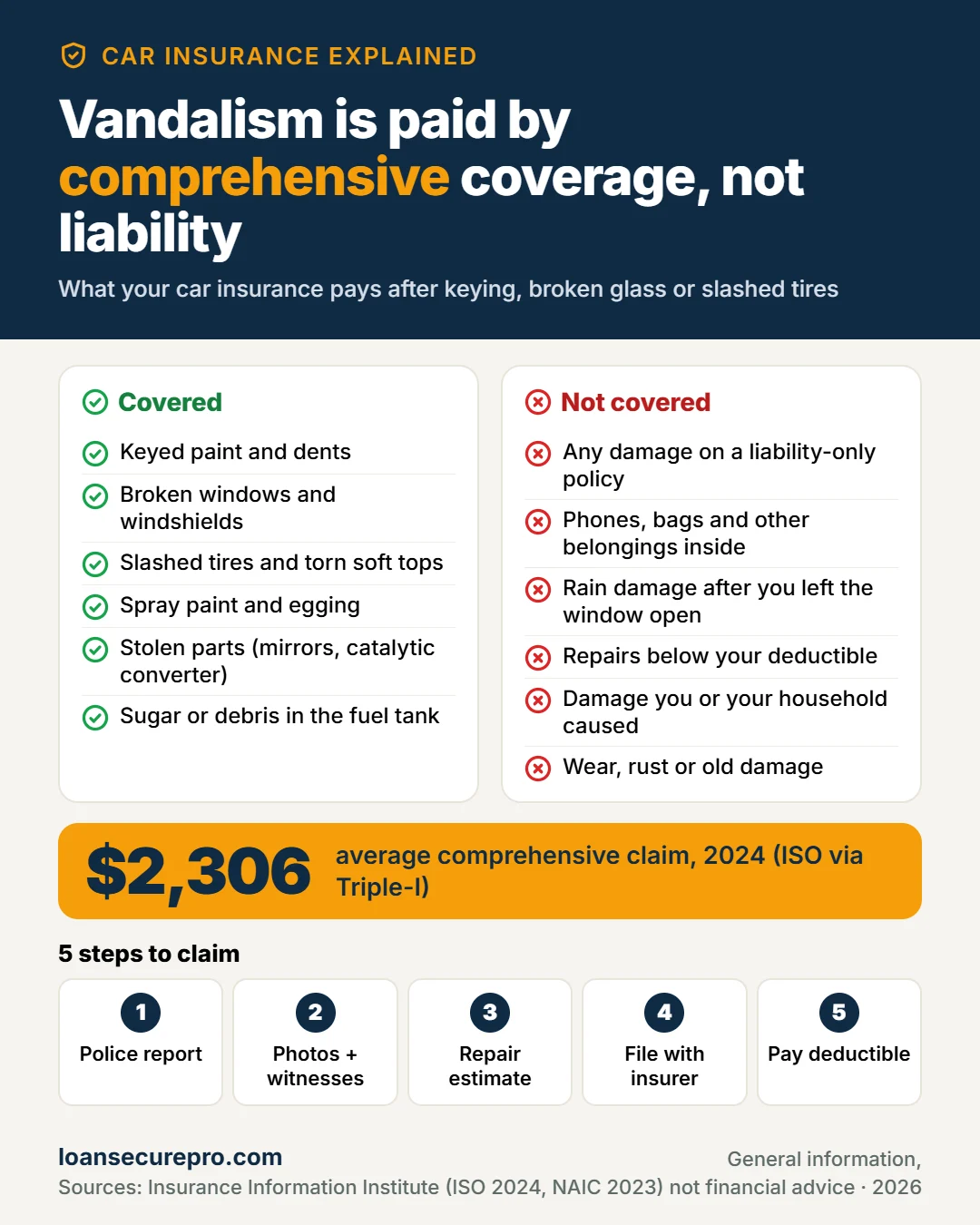
Comprehensive coverage is broad, but it is tied to the car itself. Anything that is part of the vehicle, or permanently attached to it, is generally inside the policy. Anything that was merely sitting in the car is outside it.
Usually covered under comprehensive
- Keyed, scratched or spray-painted body panels
- Dents from kicks, bats or thrown objects
- Broken windshield, windows, mirrors, lights
- Slashed tires and damaged wheels
- Torn convertible tops
- Stolen or damaged factory parts (catalytic converter, badges)
- Engine or fuel system damage from substances poured in the tank
- Permanently installed stereo or navigation equipment
Usually not covered
- Any damage if you carry liability only
- Phones, laptops, bags, tools and other loose belongings
- Aftermarket equipment above the policy’s stated limit
- Rain or further damage because you left a broken window open
- Damage caused by you, a relative in your household, or someone you let drive
- Pre-existing scratches, rust or wear noted by the adjuster
- Repairs that cost less than your deductible
Is a vandalism claim worth filing? A worked example
Filing a claim is not free, even when the policy clearly covers the damage. You pay the deductible, you may lose a claim-free discount, and some insurers raise rates after comprehensive claims. So the real question is whether the payout beats the total cost of claiming.
The formula. Insurer payout = repair cost minus deductible. Compare that to the money you might give back over the next renewal cycle through a higher premium or a lost discount. If the payout is not clearly larger, pay for the repair yourself.
The $25-a-month figure is a placeholder, not a prediction. Rate effects vary by insurer and state, and many comprehensive claims produce no increase at all. The useful habit is to ask your insurer or agent, before you file, whether a comprehensive claim of this size would change your renewal.
Repair estimates matter here too. A body shop quote for keyed paint on two panels can range from a few hundred dollars for a touch-up to well over $1,000 for a full respray. The car and the depth of the scratch decide it. Get the estimate first, then decide.
How to file a vandalism claim, step by step
Most insurers settle straightforward vandalism claims in one to three weeks. The delays almost always come from missing documents, so gather everything in the order below.
- Do not move or clean the car yet. Take wide and close-up photos of every damaged area, the surroundings, and anything the vandal left behind. Note the date, time and exact location.
- File a police report. Call the non-emergency line or file online where your city allows it. Ask for the report number. Most insurers require it for a vandalism claim, and it supports subrogation if the person is caught.
- Look for witnesses and cameras. Ask neighbours, nearby businesses and building managers whether cameras cover the spot. Get names and numbers. Footage is often overwritten within days.
- Protect the car from further damage. Cover broken glass with plastic and tape, remove valuables, and keep receipts for any temporary fixes or towing. Reasonable costs are often reimbursable.
- Get a repair estimate. Use a shop you trust, or the insurer’s network shop if you want a faster process. Ask for an itemised estimate in writing.
- Report the claim to your insurer. Use the app, website or phone line. Have the police report number, photos, estimate and a short written account ready. State clearly that the damage was intentional and not from a collision.
- Work with the adjuster. The adjuster may inspect in person or from photos. Point out every damaged area, including those that are easy to miss, such as scratched glass or bent trim.
- Approve the repair and pay the deductible. The insurer pays the shop or you, minus the deductible. Keep every document for at least a year in case a dispute or subrogation arises.
Documents checklist: police report number, dated photos and video, witness contacts, written repair estimate, receipts for temporary fixes, your policy number and the comprehensive deductible amount.
The first 72 hours: a timeline
Time matters for two reasons. Evidence disappears, and most policies require you to report a loss promptly. There is rarely a fixed deadline in the contract, but a delay of weeks invites questions about when and how the damage happened.
| When | What to do | Why it matters |
|---|---|---|
| First hour | Photograph everything, check for witnesses, secure the car | Evidence is strongest before anything is touched |
| Same day | File the police report; notify your insurer or at least open the claim | Report number is usually required; prompt notice is a policy condition |
| Day 1-2 | Ask about camera footage; get one or two repair estimates | Footage is overwritten quickly; estimates drive the file-or-not decision |
| Day 2-3 | Decide whether to claim using the worked example above; submit documents | A complete file avoids the back-and-forth that slows claims |
| Week 1-3 | Adjuster review, repair approval, payment minus deductible | Typical window for a simple comprehensive claim |
Will a vandalism claim raise your rates?
It can, but usually by less than an at-fault accident. Insurers price comprehensive claims as events outside your control, and some state regulators limit how much a comprehensive claim can be surcharged. Even so, three things can move your premium.
Claim frequency. One vandalism claim in five years rarely matters. Two or three comprehensive claims in a short period can, because insurers read frequency as a signal of risk, including where you park.
Claim-free discounts. Many insurers give a discount for a clean claims history. A single comprehensive claim may end that discount at renewal even if there is no explicit surcharge. Ask what discounts you have before you file.
Claims databases. Claims are reported to industry databases that other insurers check when you shop for a new policy. The record typically stays visible for several years, which matters if you plan to switch carriers.
Do
- Ask your agent how a comprehensive claim affects your specific renewal
- File the police report even if you decide not to claim
- Keep the estimate and photos in case damage turns out worse than it looked
- Compare the payout against the deductible before calling the claims line
Don’t
- Open a claim to “see what they say” before you have an estimate; the inquiry may be logged
- Describe the damage as an accident; vandalism is a different claim type
- Leave broken windows uncovered while you decide
- Assume stolen belongings are included; check your renters or homeowners policy
Where state and insurer rules differ
Auto insurance is regulated state by state, so the rules around vandalism claims are not identical everywhere. The coverage logic is the same, but four details change with your location and your carrier.
Glass deductibles. The Insurance Information Institute notes that some states have no deductible for windshield repair or replacement under comprehensive. If a vandal broke your windshield, check whether your state or your policy’s glass add-on waives the deductible.
Surcharge rules. Some states restrict surcharges for claims that were not the policyholder’s fault, which usually includes vandalism. Others leave it to the insurer’s filed rating plan. Your state Department of Insurance publishes consumer guides that explain the local rule.
Police report requirements. Most insurers require a report for vandalism and theft, but the timing and format vary. Some accept an online report; others want a case number from an officer.
Actual cash value limits. Every state allows insurers to cap payouts at the car’s actual cash value. On an older car, severe vandalism can total it, and the payment may be less than the repair estimate.
How to make your car a harder target
Vandalism is mostly opportunistic. Small changes in where and how you park cut the risk more than any gadget, and a few gadgets help with the claim if it happens anyway.
- Park in a garage, a gated lot or under a camera wherever you can. Well-lit, busy spots are the next best thing.
- Keep the inside of the car empty and tidy. Visible bags and electronics invite break-ins, and those are not auto claims.
- A dash camera with parking mode records impacts and movement around the car. The footage can identify the vandal and speed up the claim.
- Vary where you park if the damage looks targeted, and tell the police. A pattern may point to a dispute rather than random vandalism.
- Review your comprehensive deductible once a year against where you now park. Circumstances change; the deductible usually does not until you ask.

Honest limits of this guide
This guide explains how comprehensive coverage treats vandalism in general. Your own policy wording controls, and policies differ on glass, custom equipment limits and how promptly a loss must be reported.
The claim statistics come from industry-wide averages published by the Insurance Information Institute for 2023 and 2024. They describe the market, not your premium or your likely payout. The rate-effect figure in the worked example is a placeholder for the method, not data.
We did not test any insurer’s claims process or buy policies. Where we describe how claims usually run, that reflects published insurer guidance and regulator consumer pages, not our own claims.
When to talk to a professional
Call a licensed agent or your insurer’s claims line if you are unsure whether your policy includes comprehensive, or what your deductible is. Both questions are answered in a minute from your declarations page.
Contact your state Department of Insurance if a clear vandalism claim is denied without a written reason, or if the settlement ignores damage the adjuster saw. A public adjuster or attorney is worth considering only when the amount in dispute is large, because both take a share of the recovery.
Disclaimer: this article is general information, not insurance, legal or financial advice. Coverage depends on your policy, your state and your insurer. Confirm details with a licensed professional before relying on them.
Frequently asked questions
Does liability-only insurance cover vandalism?
No. Liability coverage pays only for injuries and property damage you cause to other people. Damage to your own car from vandalism, theft, weather or animals needs comprehensive coverage. If you carry liability only, repairs after vandalism are your own cost, though you should still file a police report.
Do I need a police report to claim vandalism on my car insurance?
Almost always. Most insurers require a police report number for vandalism and theft claims because it documents that the damage was intentional and gives them a basis for recovering money from the vandal. File the report the same day, by phone or online where your city allows it.
Is a keyed car covered by insurance?
Yes, under comprehensive coverage, minus your deductible. Keying is one of the most common vandalism claims. Get a written estimate first, because a shallow key scratch on one panel can cost less than a typical deductible, while deep scratches across several panels often cost far more.
Does car insurance cover slashed tires?
Comprehensive coverage pays for slashed tires as vandalism, after the deductible. A single tire usually costs less than a typical deductible, so many drivers pay out of pocket. Four slashed tires on a larger vehicle can exceed the deductible by enough to make a claim worthwhile.
Will a vandalism claim raise my car insurance rates?
It can, but comprehensive claims generally affect rates less than at-fault accidents. The likely effects are losing a claim-free discount or a modest increase at renewal. Repeated comprehensive claims matter more than a single one. Ask your insurer how a claim of this size would affect your renewal before filing.
Are items stolen from my car covered by auto insurance?
Usually not. Comprehensive covers the car and parts permanently attached to it, not loose belongings. Phones, laptops, bags and tools taken from the car are typically claimed under renters or homeowners insurance, subject to that policy’s deductible. The broken window itself is an auto claim.
What if the repair costs less than my deductible?
Then the insurer pays nothing, because the deductible is the part of any loss you agreed to cover yourself. In that case, pay for the repair directly and keep the estimate and police report. There is no benefit to filing, and the claim could still be recorded.
Does comprehensive cover sugar or other substances in the gas tank?
Generally yes. Deliberate contamination of the fuel system is intentional damage by another person, which is vandalism. Engine and fuel-system repairs can be expensive, so this is often a claim worth filing. Document the contamination before the mechanic drains the tank, and keep the shop’s written findings.
How long do I have to report vandalism to my insurer?
Policies require prompt notice rather than a fixed number of days, and state time limits for filing a claim are usually measured in years. In practice, report within a day or two. Long delays make it harder to prove when the damage happened and may lead the insurer to question the claim.
Does vandalism count as an accident on my record?
No. Vandalism is a comprehensive loss, not a collision or an at-fault accident. It does not add points to your driving record. It can appear in industry claims databases that insurers check, which is why multiple comprehensive claims in a short period can still affect your rates.
The bottom line
Vandalism is covered by car insurance when, and only when, your policy includes comprehensive coverage. You pay the deductible and the insurer pays the rest of the repair, up to the car’s value. Liability-only policies leave the whole bill with you, and belongings stolen from the car belong on a renters or homeowners claim.
Before you file, get an estimate and run the simple math: repair cost minus deductible, compared with any likely rate effect. Small losses are usually better paid out of pocket; larger ones are what comprehensive coverage exists for.
Either way, file the police report, photograph everything and act within the first day. If you are also dealing with a parked-car collision, our guide to whether car insurance covers hit-and-runs explains the different claim path.
Sources
- Insurance Information Institute: What is covered by a basic auto insurance policy? (accessed Oct 30, 2026)
- Insurance Information Institute: Facts and statistics, auto insurance, ISO/Verisk 2024 claim data and NAIC 2023 coverage data (accessed Oct 30, 2026)
- NAIC consumer resources and state insurance department directory (accessed Oct 30, 2026)



One Comment