Car Insurance for Low-Income Drivers: State Programs, Costs and Savings
Written by Rakib Sarwar, 15 years in banking and lending · Last updated: October 31, 2026
Why trust this guide: every program rule and price below comes from the California Department of Insurance (March 2026 report), the New Jersey Department of Banking and Insurance, Insurance.com and Insure.com (updated May 29, 2026), and we name the source each time. We do not sell insurance.
Disclosure: this page may carry ads or links to insurance partners. They do not affect what we write, and we never recommend a policy because of a commission.
When money is tight, car insurance is a bill you cannot skip and cannot easily shrink. Most states require liability coverage, and the average price depends more on where you live than on what you earn. The question is whether any help exists beyond ordinary shopping.
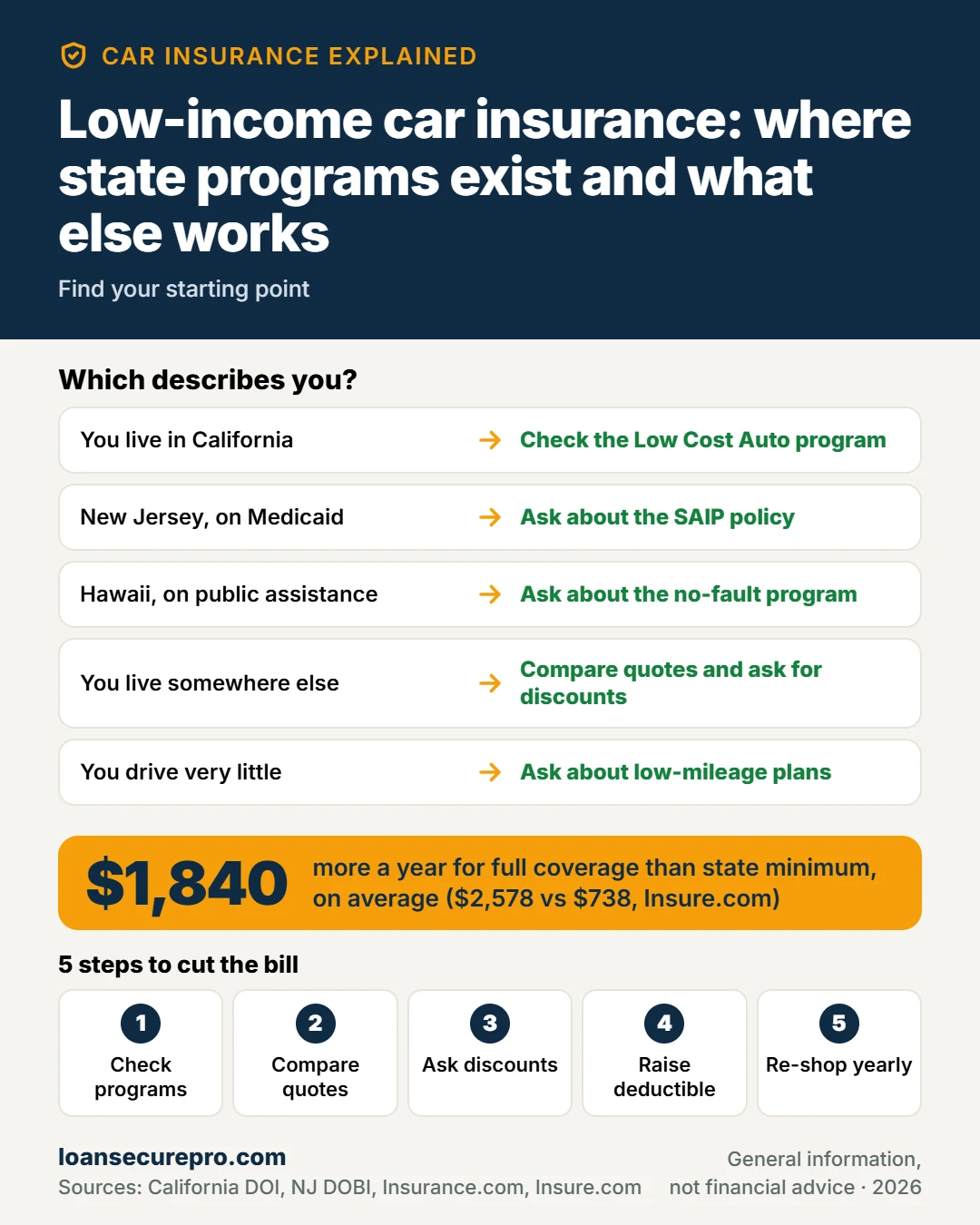
Government help for car insurance is limited and varies a lot by state, so check your own state first. Help exists in only a few places. Insurance.com says three states run low-income auto programs: California, Hawaii and New Jersey, while Insure.com names only California and New Jersey. California’s program sells liability cover with $3,000 of property damage limit, and New Jersey’s $365 policy has no liability cover at all. Everywhere else, you save by comparing quotes, trimming coverage carefully and asking for discounts. On average, full coverage costs $2,578 a year against $738 for state minimum, per Insure.com.
In short: check whether your state has a program, read exactly what it leaves out, then compare quotes and discounts before you cut coverage.
The danger is saving money in a way that leaves you exposed. A cheap policy that pays almost nothing after a crash can cost far more than a mid-priced one, so this guide shows the gaps as well as the prices.
This guide is for US drivers. It uses California’s 2026 legislative report, New Jersey’s official policy page, Insurance.com and Insure.com. It shows where they disagree, works through the coverage gap in numbers, and lists every savings tactic with its trade-off.

Key takeaways
- Insurance.com names three state programs (CA, HI, NJ); Insure.com names two (CA, NJ).
- California’s program lists limits of $10,000, $20,000 and $3,000, below the state minimum of $30,000, $60,000 and $15,000.
- California income limits start at $39,900 for one person and rise $14,200 for each added person, per the state’s 2026 report.
- New Jersey’s SAIP costs $365 a year, about $1 a day, but excludes liability and collision cover.
- Average state minimum is $738 a year and full coverage is $2,578, per Insure.com, a gap of about $1,840.
- County liability prices in California run from $199 to $418 per vehicle, effective May 1, 2025.
- Outside those states, comparison shopping, discounts and mileage plans are the main tools.
In this guide
- What car insurance costs on a low income
- California’s Low Cost Auto program
- New Jersey and Hawaii programs
- Worked example: what cheap coverage leaves out
- Ways to save, with trade-offs
- How to find affordable coverage, step by step
- Mistakes to avoid
- Where state and insurer rules differ
- Honest limits of this guide
- When to talk to a professional
- Frequently asked questions
What car insurance costs on a low income
No source publishes a price list for low-income drivers as a group. What Insure.com (updated May 29, 2026) does give is national averages for the two coverage levels you will be choosing between.
| Coverage level | Average per year | What it means |
|---|---|---|
| State minimum | $738 | Cheapest legal option in most states |
| Full coverage | $2,578 | About $1,840 more than minimum |
Where you live changes the picture sharply. Insure.com lists average state-minimum premiums of $339 in Wyoming, $392 in Vermont, $1,303 in Michigan and $1,395 in New Jersey.
| State | Average state-minimum premium |
|---|---|
| Wyoming | $339 |
| Vermont | $392 |
| Michigan | $1,303 |
| New Jersey | $1,395 |
That is a spread of more than four to one, so the minimum in Michigan costs nearly four times what it does in Wyoming. Insure.com does not name its data source, so treat these as ballpark figures.
California’s Low Cost Auto program
California’s Low Cost Automobile Insurance Program (CLCA) is run by the state Department of Insurance. Its 2026 legislative report counted 66,998 active policies on December 31, 2025.
| Requirement | What the state says |
|---|---|
| License | Valid California driver’s license |
| Age | At least 16; under 18 must be legally emancipated |
| Vehicle value | $25,000 or less |
| Driving record | Good record, or a new driver |
| Income | Within limits for household size (table below) |
Income limits in the state’s 2026 report rise by the same $14,200 for each extra household member.
| Household size | Maximum income |
|---|---|
| 1 person | $39,900 |
| 2 people | $54,100 |
| 3 people | $68,300 |
| 4 people | $82,500 |
| 5 people | $96,700 |
The program sells liability cover only. Its listed limits are $10,000 per person and $20,000 per accident for bodily injury or death, and $3,000 per accident for property damage. In the report, county liability premiums range from $199 to $418 per vehicle, effective May 1, 2025.
For example, Alameda County is listed at $418 for liability, $54 for uninsured motorist bodily injury and $24 for medical payments. The program also lists higher prices for youthful and inexperienced drivers, such as $920 for ages 16 to 18 in Alameda.
Insurance.com adds that the program does not sell insurance directly. It assigns a licensed insurer through the California Automobile Assigned Risk Plan. You can reach the program at mylowcostauto.com.
New Jersey and Hawaii programs
New Jersey’s Special Automobile Insurance Policy (SAIP) is for people in a very specific position, and it is not ordinary car insurance. The state’s own page describes who qualifies and what the policy leaves out.
| Item | New Jersey SAIP, per the state |
|---|---|
| Who qualifies | People enrolled in Federal Medicaid with hospitalization; not all Medicaid programs count |
| Price | $365 a year, or $360 if paid in full up front |
| What it pays | Emergency treatment after an accident and serious brain and spinal cord injuries up to $250,000, plus a $10,000 death benefit |
| What it does not cover | Outpatient care Medicaid covers, liability for damage to others, and collision or comprehensive on your own car |
| Limits | One car per policy; suspended or revoked license or registration disqualifies you |
Medicaid enrollment must be shown when the policy is first written and at each renewal. You can get it from most insurance agencies or by calling the PAIP customer service line.
Hawaii runs a no-fault program for people who receive public assistance, according to Insurance.com. It lists minimum coverage of 20/40/10 plus $10,000 in personal injury protection, limited to one vehicle per household except in specific circumstances. We could not verify details with a Hawaii agency, so contact the state directly.
Worked example: what cheap coverage leaves out
These numbers combine the state’s limits with an assumed crash, so they are illustrations, not quotes. The point is how little the cheapest cover pays after a bad accident.
On the numbers shown, the program can save roughly $320 to $539 a year against the national average minimum. In an assumed $22,000 crash it could leave you $12,000 more exposed.
Whether the trade is worth it depends on what you own and what you could lose. If you have little to protect, a low limit may be acceptable. If you own a home or have savings, a judgment could reach well beyond $3,000.
Ways to save, with trade-offs
Insure.com lists the main levers. Each one lowers the price by shifting some risk back to you, so the table shows the cost of using it.
| Tactic | What it does | Trade-off |
|---|---|---|
| Drop to state minimum | Cuts the average bill by about $1,840 a year | Your own car is not covered after a crash |
| Compare quotes | Prices vary widely between insurers | Takes an hour or two |
| Ask for discounts | Safe-driving, bundling and paid-in-full discounts | Amounts vary and are not published |
| Low-mileage or pay-per-mile plan | Insure.com says it can cut premiums by 30 percent or more (unsourced) | Works only if you drive little |
| Raise your deductible | Lowers the premium | You pay more out of pocket on a claim |
| Cheaper-to-repair vehicle | Lowers repair and theft risk | Only helps when you change cars |
Our guide on how to lower your car insurance premium covers the other levers. If you drive little, see our guide to the best car insurance for low-mileage drivers.
Before you raise a deductible, work out whether you could pay it tomorrow. Our guide on how car insurance deductibles work shows how the number changes your risk.
How to find affordable coverage, step by step
- Check for a state program. The sources name California, New Jersey and, per Insurance.com, Hawaii.
- Confirm eligibility. For California, check income, vehicle value, age and record; for New Jersey, check Medicaid type.
- Read what the program excludes. Note the limits and the missing cover before you apply.
- Get quotes for minimum and full coverage. Ask at least three insurers for identical limits.
- Ask about discounts. Request safe-driving, bundling and paid-in-full discounts by name.
- Price a mileage plan. If you drive little, ask for a low-mileage or pay-per-mile quote.
- Pick a deductible you can pay. Choose an amount you could cover from savings within days.
- Re-check every year. Re-shop at renewal, and confirm you still qualify for any program, since New Jersey requires proof of Medicaid at each renewal.
Information to have ready: your driver’s license, vehicle registration, vehicle value, household size and income, and a Medicaid ID if you are applying in New Jersey.

Mistakes to avoid
These errors cost low-income drivers the most, because a single uncovered loss can wipe out months of savings.
Treating a state program as full insurance. New Jersey’s SAIP excludes liability for other people’s property and collision cover on your own car, per the state.
Driving uninsured to save the premium. Most states require liability cover, and one at-fault crash can dwarf a year of premiums.
Picking the cheapest quote without matching limits. A low price can reflect lower limits, so compare identical coverage.
Letting the policy lapse. A gap in coverage can raise prices and make coverage harder to get later.
Do
- Check state programs first
- Compare identical limits
- Ask about every discount
- Choose a deductible you can pay
- Re-check eligibility each year
Don’t
- Assume a program covers your own car
- Drop liability to save money
- Skip comparison because a quote is low
- Let coverage lapse
- Hide household drivers or mileage
Where state and insurer rules differ
Three things vary: whether your state has a program, what the minimum limits are, and what insurers charge.
Programs. Insurance.com names California, Hawaii and New Jersey. Insure.com names California and New Jersey only. In any other state, assume no income-based program exists until your state insurance department says otherwise.
Minimum limits and prices. California raised its minimums to $30,000, $60,000 and $15,000 on January 1, 2025. Average minimum premiums run from $339 in Wyoming to $1,395 in New Jersey, per Insure.com.
Insurer discounts. Insure.com says major insurers offer low-income or usage-based discounts but gives no amounts. Ask each company what it offers and what documents it needs.
Honest limits of this guide
This guide cannot tell you what you will pay or whether you qualify. Program rules change, and the figures here come from sources dated from July 2024 to May 2026.
The sources disagree in places. Insurance.com lists a California family-of-four limit of $78,000, while the state’s 2026 report says $82,500, so we used the state’s table. Insure.com says applicants must be 18, while the state says 16, and we used the state. Insure.com does not name the data behind its averages.
The worked examples use assumed crash costs and mix a California county range with a national average, so they are not like for like. We did not contact any program or insurer.
When to talk to a professional
A licensed independent agent can quote several insurers at once and tell you which discounts apply in your state. Say plainly that price is the priority, and ask for a quote at your state minimum and at one step above it.
For program questions, call the program or your state Department of Insurance. If you have already had a crash with low limits and the other party is claiming more than your policy pays, speak with a licensed attorney in your state.
Disclaimer: this article is general information, not insurance, legal or financial advice. Coverage and prices depend on your policy, your state and your insurer. Confirm details with a licensed professional before relying on them.
Frequently asked questions
Is there government car insurance for low-income drivers?
In a few states. Insurance.com names California, Hawaii and New Jersey, while Insure.com names California and New Jersey. Each program has strict eligibility and limited coverage. Elsewhere you rely on private insurers, so compare quotes and ask about discounts instead.
Who qualifies for California’s Low Cost Auto program?
Per the state, you need a valid California license, a vehicle worth $25,000 or less, age 16 or older, a good driving record or new-driver status, and income within limits. The 2026 limit is $39,900 for one person and $82,500 for four. Check current rules before applying.
How much does California’s Low Cost Auto cost?
The state’s 2026 report lists county liability premiums from $199 to $418 per vehicle, effective May 1, 2025. Alameda County is $418, with $54 extra for uninsured motorist bodily injury and $24 for medical payments. Younger and inexperienced drivers pay more, so request a quote.
What does New Jersey’s SAIP cover?
It pays emergency treatment after an accident and serious brain and spinal cord injuries up to $250,000, plus a $10,000 death benefit. It does not cover liability for other people’s property or damage to your own car. It costs $365 a year and requires Medicaid with hospitalization.
Is state minimum coverage enough?
It may be legal but not enough. Minimum limits pay others up to a fixed amount, and anything beyond that falls on you. In our example, a $22,000 repair bill leaves you owing $7,000 at a $15,000 limit. Consider what you could lose before choosing minimum.
How much cheaper is minimum coverage than full coverage?
On average, about $1,840 a year, per Insure.com: $738 for state minimum versus $2,578 for full coverage. The saving comes from dropping protection for your own car, so only choose minimum if you could replace or repair the car yourself after a crash.
Do pay-per-mile plans help low-income drivers?
They can if you drive little. Insure.com says pay-per-mile or low-mileage plans can cut premiums by 30 percent or more, though it gives no source for the figure. Ask for a quote and compare it against a standard policy at the same limits.
Do insurers offer low-income discounts?
Some do. Insure.com says major insurers offer low-income or usage-based discounts but lists no amounts. Ask each company what it offers, what documents it needs, and whether it can be combined with safe-driving, bundling or paid-in-full discounts.
Can I get coverage if I cannot pay all at once?
Often, but terms vary. Insure.com lists paid-in-full discounts among the ways to save, so ask what an upfront payment is worth. New Jersey’s SAIP can be paid in two installments totaling $365, or $360 if paid in full. Ask any insurer about payment options before you buy.
What if I cannot afford any insurance?
Do not drive uninsured without checking your state’s rules, since most states require liability cover. Call your state insurance department about assistance, ask an agent for the lowest legal quote, and consider a low-mileage plan. Skipping coverage can cost far more after one crash.
The bottom line
Low-income drivers have real options, but fewer than the ads suggest. Only a few states run programs, and the cheapest policies leave large gaps. The best savings come from comparing identical coverage, claiming every discount and choosing a deductible you can actually pay.
This week, check whether your state has a program, request three quotes at the same limits, and ask each insurer about low-income and mileage discounts. Then set a reminder to repeat the comparison before renewal.
Sources
- California Department of Insurance: Low Cost Automobile Insurance Program 2026 legislative report (Mar 15, 2026) (accessed Oct 31, 2026)
- California Department of Insurance: California’s Low-Cost Auto Insurance (July 23, 2024) (accessed Oct 31, 2026)
- New Jersey Department of Banking and Insurance: Special Automobile Insurance Policy (SAIP) (accessed Oct 31, 2026)
- Insurance.com: Government car insurance for low-income drivers (accessed Oct 31, 2026)
- Insure.com: Car insurance for low-income drivers (updated May 29, 2026) (accessed Oct 31, 2026)