Can You Get Car Insurance With an Expired License? What Insurers Do
Written by Rakib Sarwar, 15 years in banking and lending · Last updated: October 31, 2026
Why trust this guide: every rule and figure below comes from Insurify (updated Oct 29, 2026), LendingTree (Oct 5, 2026), The Clearvestor (Jan 2026) and Policygenius (Mar 2022), and we name the source each time. We do not sell insurance.
Disclosure: this page may carry ads or links to insurance partners. They do not affect what we write, and we never recommend a policy because of a commission.
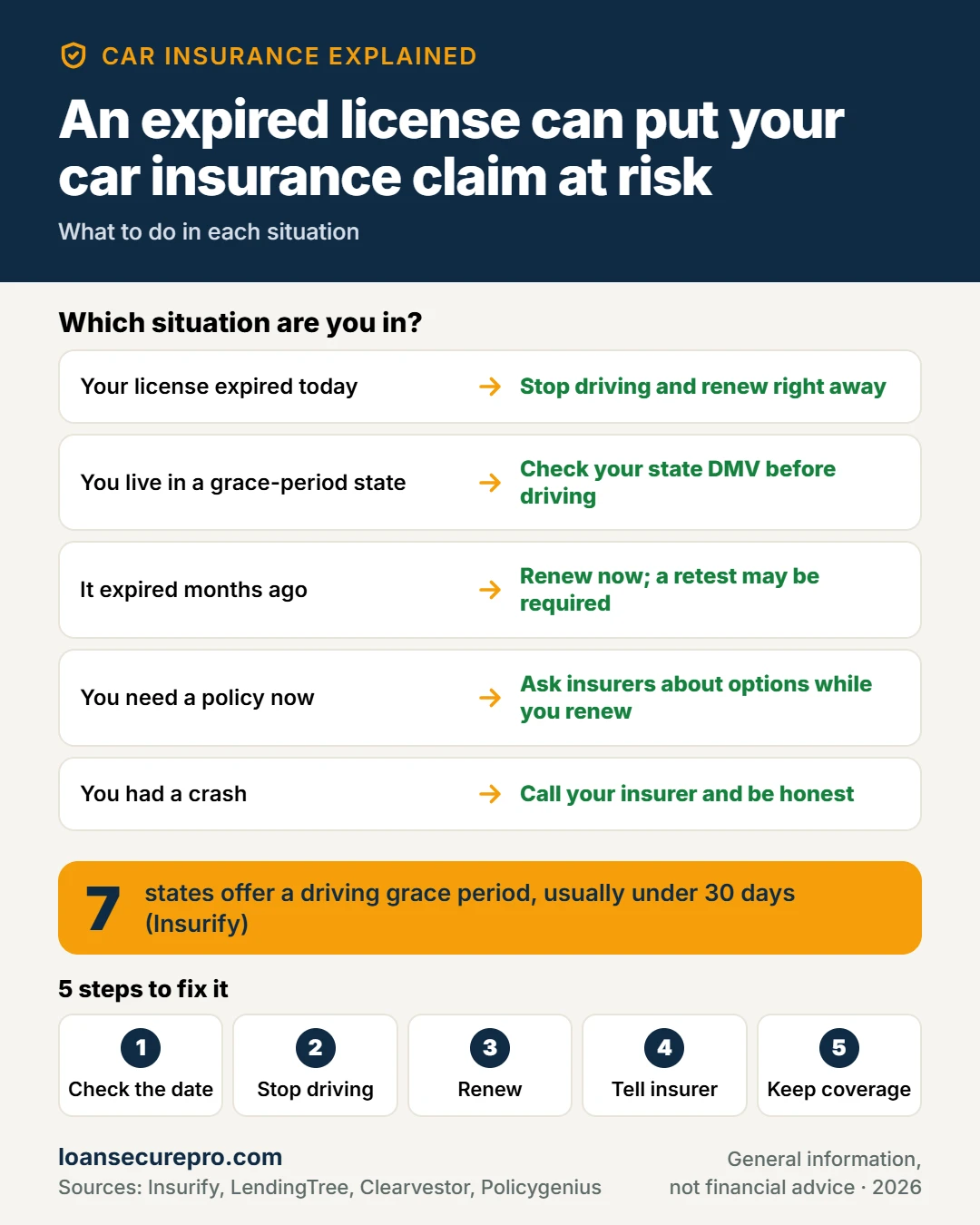
Your license expires on a Tuesday, you do not notice, and your insurance bill arrives on Friday. The question most drivers ask next is whether the policy still works, and the honest answer depends on which of three things you mean: buying a new policy, keeping an old one, or getting a claim paid.
Most insurers will not issue a new car insurance policy on an expired license, according to The Clearvestor. An existing policy does not necessarily end when the license expires, LendingTree says, but your insurer can refuse a claim after a crash. Insurify adds that insurers typically will not pay claims that involve a moving violation while you drive on an expired license. Only seven states offer a driving grace period, usually under 30 days, so the safe move is to stop driving and renew before you get behind the wheel.
In short: do not drive on an expired license, renew as fast as your state allows, keep your policy active and tell your insurer once you are valid again.
The difference between a new policy and a claim matters because the risk is not equal. A rejected application costs you time. A rejected claim after a serious crash can cost tens of thousands of dollars.
This guide is for US drivers. It combines four sources, shows where they disagree on fines, works through the cost of waiting versus renewing, and lists the steps to fix an expired license while keeping your coverage in place.

Key takeaways
- Most insurers will not issue a new policy on an expired license, per The Clearvestor (Jan 2026).
- An existing policy is not automatically cancelled, but a claim can be refused, per LendingTree and Insurify.
- Insurify names only seven states with a driving grace period: AL, CO, HI, IA, NM, OK and VT.
- Fines range from $50 in Utah to up to $2,500 and a year in jail in Illinois, per Policygenius.
- A renewal window is not a driving window: California allows online renewal up to 12 months after expiry, but driving is still illegal.
- If you must pay a crash out of pocket, the bill can reach thousands of dollars, per Policygenius.
- Keep your insurance active while you renew, and tell your insurer afterward.
In this guide
- What an expired license means for your insurance
- Why insurers care about a valid license
- Grace periods: which states have them
- Fines and penalties by state
- Worked example: renewing now versus waiting
- How to fix an expired license, step by step
- Options if you need coverage while you renew
- Mistakes to avoid
- Where state and insurer rules differ
- Honest limits of this guide
- When to talk to a professional
- Frequently asked questions
What an expired license means for your insurance
An expired license changes three different situations, and the answers are not the same. The table summarizes what the four sources say.
| Situation | What the sources say | Risk |
|---|---|---|
| Buying a new policy | The Clearvestor: most insurers will not issue one. Temporary purchase may be allowed in some cases, but it is not common. | High |
| Keeping an existing policy | LendingTree: a policy does not necessarily end when the license expires. The Clearvestor: some insurers may cancel or suspend it once they learn. | Medium |
| Claim after a crash | Insurify: your insurer can refuse coverage, with rare exceptions. LendingTree: an expired license does not automatically mean a denial. | Highest |
| Ticket from police | LendingTree: a citation is possible even if you did not know the license had expired. | Certain if stopped |
The pattern is that insurers are most flexible before anything goes wrong and least flexible after. A policy that looks fine on your screen can still fail when a claim adjuster checks your license status.
Why insurers care about a valid license
A license is the insurer’s proof that the state has approved you to drive. Policies are priced on the assumption that every listed driver is legally allowed on the road, so driving without a valid license usually breaks a condition of the contract.
The Clearvestor says policies often contain clauses that void coverage if you drive without a valid license, which can leave you personally responsible for damages and medical bills. Insurify says that in most cases the driver is in violation of the policy.
There is one exception worth knowing. Insurify says some insurers may cover an accident if your state has a grace period, though the exceptions are rare and depend on your policy and state.
Grace periods: which states have them
Insurify says the only states that offer grace periods are Alabama, Colorado, Hawaii, Iowa, New Mexico, Oklahoma and Vermont. It adds that these generally last under 30 days. Policygenius also says some states offer a short grace period, usually under 30 days, but does not name them.
Be careful with the word “grace.” LendingTree reports that California lets eligible drivers renew online up to 12 months after expiration, and New York lets drivers renew up to two years after. Both states still warn that driving on an expired license is illegal.
| Term | What it means | Can you drive? |
|---|---|---|
| Driving grace period | A short window after expiry when driving may not be penalized, in the seven states Insurify names | Only in those states, and only briefly |
| Renewal window | The time after expiry when you can still renew without a full retest, such as 12 months in California | No |
| Retest requirement | If the license has been expired a long time, you may pay a large fee or retake a driving test (Policygenius) | No |
Insurify also notes that grace periods for retaking a driving exam are a different thing from a driving grace period. If you are unsure which applies to you, confirm with your state DMV before you drive.
Fines and penalties by state
Penalties for an expired license range from a small infraction to a misdemeanor with jail time. The sources do not agree for every state, so the table shows both. Policygenius lists expired-license penalties (March 2022). Insurify lists first-offense penalties for driving without a license and says expired-license penalties may match.
| State | Policygenius (expired license) | Insurify (no license, first offense) |
|---|---|---|
| Alabama | $10 to $100 plus a $50 fund penalty | $10 to $100 plus a $50 fine; up to 180 days; impound |
| California | Up to six months in jail; up to $1,000 | 5 days to 6 months; $300 to $1,000 |
| Florida | Up to $500; up to 60 days | Up to $500; up to 60 days |
| Illinois | Up to one year; up to $2,500; impound | Up to one year; up to $2,500 |
| Pennsylvania | $200, or $25 if expired under a year | $200; suspension extended a year |
| Texas | Up to $200 | Up to $500 |
| Vermont | $162 | Up to 2 years; up to $5,000 |
| Washington | $250, or $50 with a valid license by the court date | Up to 364 days; up to $5,000 |
| Wisconsin | $100 if under three months; otherwise $200 to $500 | $100 if under three months |
The gaps between the columns are large. Washington’s expired-license fine is $250 in one source and up to $5,000 in the other, which shows how much the label “expired” versus “no license” can matter in court.
Worked example: renewing now versus waiting
The purpose of this example is to compare a small certain cost with a large uncertain one. The numbers are assumptions, not quotes, and your state will differ.
A $40 renewal is about 0.1 percent of the $39,000 loss in this scenario. Even the highest fine in the table is small beside a refused claim.
Policygenius makes the same point in words: if you are at fault and uninsured, you may pay out of pocket, which could cost hundreds, or even thousands of dollars. The $39,000 figure is an illustration of a serious crash, not a typical one.
How to fix an expired license, step by step
- Check the expiration date. It is printed on the card and usually falls on your birthday, per Insurify.
- Stop driving. Unless you have confirmed a grace period with your state DMV, do not drive until you are renewed.
- Read your DMV’s renewal page. Rules and fees differ by state, and some drivers must retest.
- Gather your documents. Insurify lists your current license, Social Security number and proof of address.
- Choose how to renew. Policygenius says online is available in most states, in person in every state, and by mail for some.
- Pay any late fee and pass any retest. A long-expired license can mean a hefty fee or a driving test, per Policygenius.
- Tell your insurer. Once you have a valid license, confirm it with your company and ask whether anything on the policy changes.
- Keep insurance active throughout. Insurify advises keeping coverage in force during renewal, and shredding the expired card.
Information to have ready: your expired license number, your policy number, your vehicle identification number and the date your license expired.

Options if you need coverage while you renew
Insurify notes that some states require continuous liability insurance on registered vehicles, so your state may require the car to stay insured even if you cannot drive it. These are the options the sources describe.
| Option | What the source says | Caution |
|---|---|---|
| Keep your current policy | LendingTree: a policy does not necessarily end at expiry | Tell the insurer when you renew |
| Restricted or non-standard policy | The Clearvestor: some insurers offer them, but they are costly and limited | Compare against waiting a few days |
| Park the car, comprehensive only | CarInsuranceComparison (Nov 2024) lists parked-car coverage | Confirm with your insurer first |
| Let a licensed person drive | CarInsuranceComparison lists naming another licensed primary driver | Disclose all household drivers |
Non-owner insurance is often mentioned in this context, but it covers you when you drive cars you do not own, not when your own license is invalid. The Clearvestor even says it typically requires a valid license. See our guide on what is non-owner car insurance before you assume it helps.
If you let the policy end while you sort out the license, you create a second problem. Our guide on what happens if your car insurance lapses explains why a gap can make coverage harder and pricier later.
Mistakes to avoid
These four errors turn a paperwork problem into an expensive one.
Assuming the policy covers you. Insurers can refuse claims in most expired-license crashes. Treat coverage as uncertain until you are renewed.
Confusing a renewal window with permission to drive. You may be able to renew up to a year late in some states, but driving in that period is still illegal in California and New York, per LendingTree.
Cancelling insurance in frustration. A lapse can raise your premium later and make coverage harder to get, per Insurify.
Borrowing a car. Your own license problem does not disappear in someone else’s vehicle. See whether you can drive someone else’s car with your insurance and why a valid license is part of the answer.
Do
- Check your expiry date today
- Renew before you drive
- Keep your policy active
- Tell your insurer after you renew
- Ask the DMV about retest rules
Don’t
- Assume a grace period applies to you
- Drive “just once” to the DMV
- Cancel the policy while you wait
- Hide the expired date from your insurer
- Borrow a car to avoid the issue
Where state and insurer rules differ
Three things vary: whether your state has a driving grace period, how late renewal works and what the court can charge. The fine table above shows how far apart the numbers can be.
Grace periods. Only Alabama, Colorado, Hawaii, Iowa, New Mexico, Oklahoma and Vermont are named by Insurify. If you live elsewhere, assume you cannot drive from the day after expiry.
Renewal rules. California and New York allow late online renewal for a year or two, according to LendingTree. Other states may require an in-person visit or a retest sooner.
Insurer behavior. The Clearvestor says some insurers may allow a short grace period while you renew, but this is rare and varies by company. Ask yours before you rely on it.
Honest limits of this guide
This guide summarizes four sources and cannot tell you what your insurer will do. Policy wording, state law and the facts of a crash decide each case.
The fine figures are from March 2022 (Policygenius) and October 2026 (Insurify), and they disagree for several states. Treat them as ranges and check your state’s current statute or court. We did not call any insurer or DMV.
The CarInsuranceComparison page is dated November 2024 and contradicts itself on whether you can buy a policy, so we used it only to list alternatives, not its statistics. The worked example uses assumed amounts and is not a quote.
When to talk to a professional
Call your insurer or a licensed independent agent as soon as you notice the expiry. Ask three direct questions: is my current policy still in force, would a claim today be paid, and what do you need from me after I renew.
If you have already been in a crash, been cited or been told a claim is denied, speak with a licensed attorney in your state. Your state Department of Insurance can also explain how to dispute a denial.
Disclaimer: this article is general information, not insurance, legal or financial advice. Coverage and prices depend on your policy, your state and your insurer. Confirm details with a licensed professional before relying on them.
Frequently asked questions
Can you get car insurance with an expired license?
Usually not for a new policy. The Clearvestor says most insurers will not issue one, and temporary purchases are uncommon. An existing policy may stay in force, per LendingTree, but getting coverage can be more difficult. Renew first, then shop, and ask insurers about any restricted options.
Will insurance pay if I crash with an expired license?
Not reliably. Insurify says your insurer can refuse coverage, with rare exceptions, and typically will not pay claims involving a moving violation. LendingTree adds that an expired license does not automatically mean denial. Outcomes depend on your policy, your state and who was at fault.
Can my insurer cancel my policy if my license expires?
It can. The Clearvestor says some insurers may cancel or suspend a policy once they learn the license has expired, while others allow a short grace period, which is rare. Insurify also says insurers may cancel for violating the policy. Renew quickly and tell your insurer.
How long can you drive on an expired license?
In most states, not at all. Insurify says only seven states offer a driving grace period, generally under 30 days. LendingTree says there is no universal grace period for driving. Check your state DMV, because renewal deadlines and driving rules are different.
Which states have a grace period for expired licenses?
Insurify names Alabama, Colorado, Hawaii, Iowa, New Mexico, Oklahoma and Vermont, and says the periods are generally under 30 days. Policygenius says some states offer a short grace period but does not list them. Confirm with your DMV, because rules change.
Can I renew online after my license expired?
Often yes, within limits. LendingTree says California allows eligible drivers to renew online up to 12 months after expiry and New York up to two years. Policygenius says online renewal is available in most states, with exceptions. A long-expired license may require a fee or a driving test.
What are the penalties for driving on an expired license?
They range widely. Policygenius lists $50 in Utah, $200 in Pennsylvania and up to $2,500 plus a year in jail in Illinois. Insurify’s no-license table shows higher maximums in some states. Courts may add fees, per LendingTree, so ask the court for the total.
Does an expired license raise my car insurance rate?
It can. The Clearvestor says premiums can increase dramatically after expired-license violations, and restricted policies cost more. Insurify warns that a lapse in coverage can raise future premiums. No source gives a reliable figure, so compare quotes after you renew.
What if I did not know my license had expired?
You can still be cited. LendingTree says a citation is possible even if you did not know the license had expired. Stop driving, renew as soon as possible and keep proof of the renewal date. A court may take your prompt fix into account, but outcomes vary.
Do I need insurance if I am not driving my car?
Sometimes. Insurify notes that some states require continuous liability insurance on registered vehicles. Keep your policy active during renewal, and ask your insurer about lower-cost options for a parked car instead of cancelling and creating a coverage gap.
The bottom line
An expired license is a small problem that becomes a large one the moment you drive. New policies are hard to get, old policies may not pay a claim, and fines vary from $50 to thousands of dollars.
Today, check your expiration date, stop driving if it has passed, renew through your DMV and tell your insurer afterward. Keep the policy active the whole time so you do not trade a license problem for a coverage gap.
Sources
- Insurify: Can you legally drive with an expired license? (updated Oct 29, 2026) (accessed Oct 31, 2026)
- LendingTree: Can you drive with an expired license? (Oct 5, 2026) (accessed Oct 31, 2026)
- The Clearvestor: Can you get car insurance with an expired license? (Jan 11, 2026) (accessed Oct 31, 2026)
- Policygenius: How long can you drive with an expired license? (Mar 4, 2022) (accessed Oct 31, 2026)