Can I Drive Someone Else’s Car With My Insurance? Who Pays
Written by Rakib Sarwar, 15 years in banking and lending · Last updated: October 31, 2026
Why trust this guide: every rule and figure below comes from NerdWallet, MoneyGeek, Progressive, AAA, Credit Karma or InsuranceQuotes.com, with the date stated where one is given. We do not sell insurance.
Disclosure: this page may carry ads or links to insurance partners. They do not affect what we write, and we never recommend a policy because of a commission.
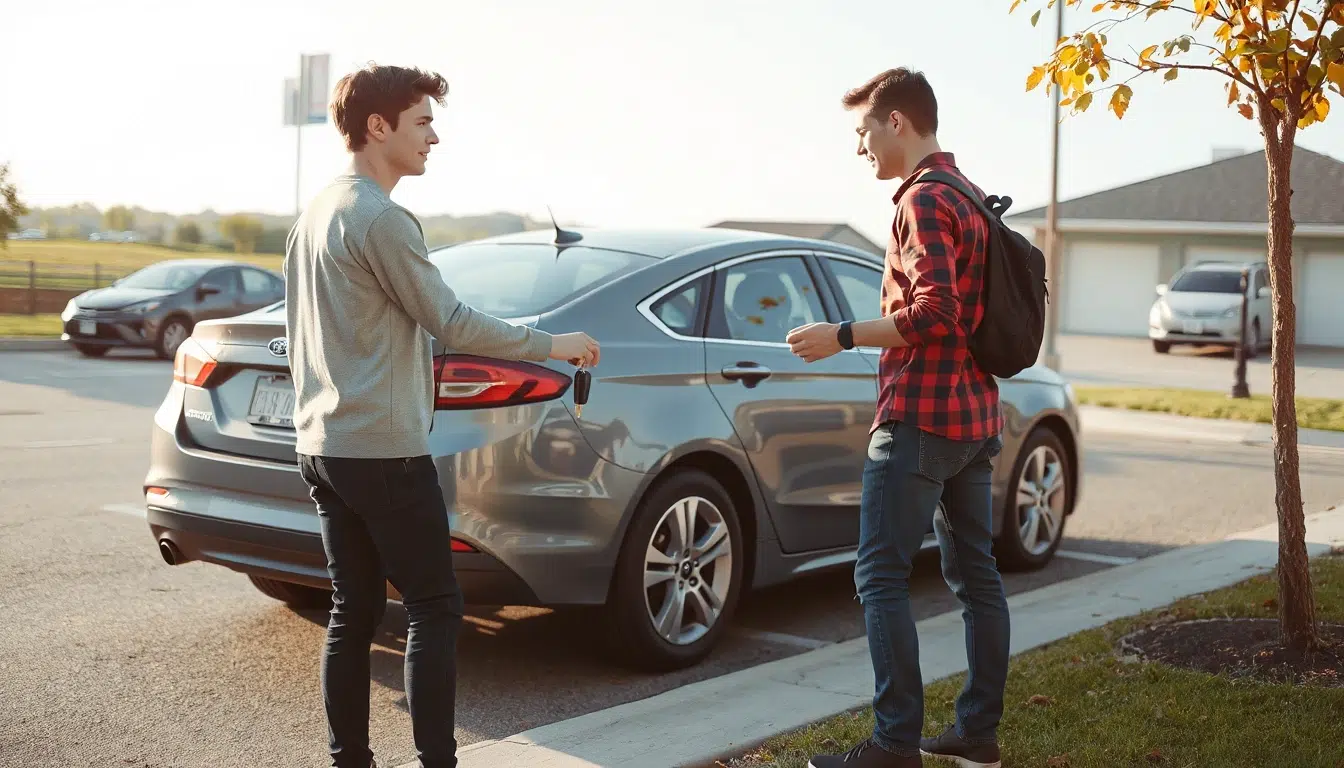
A friend hands you the keys, or a relative asks you to move their car, and you wonder what happens if something goes wrong. Your name is on a policy, but the car belongs to someone else.
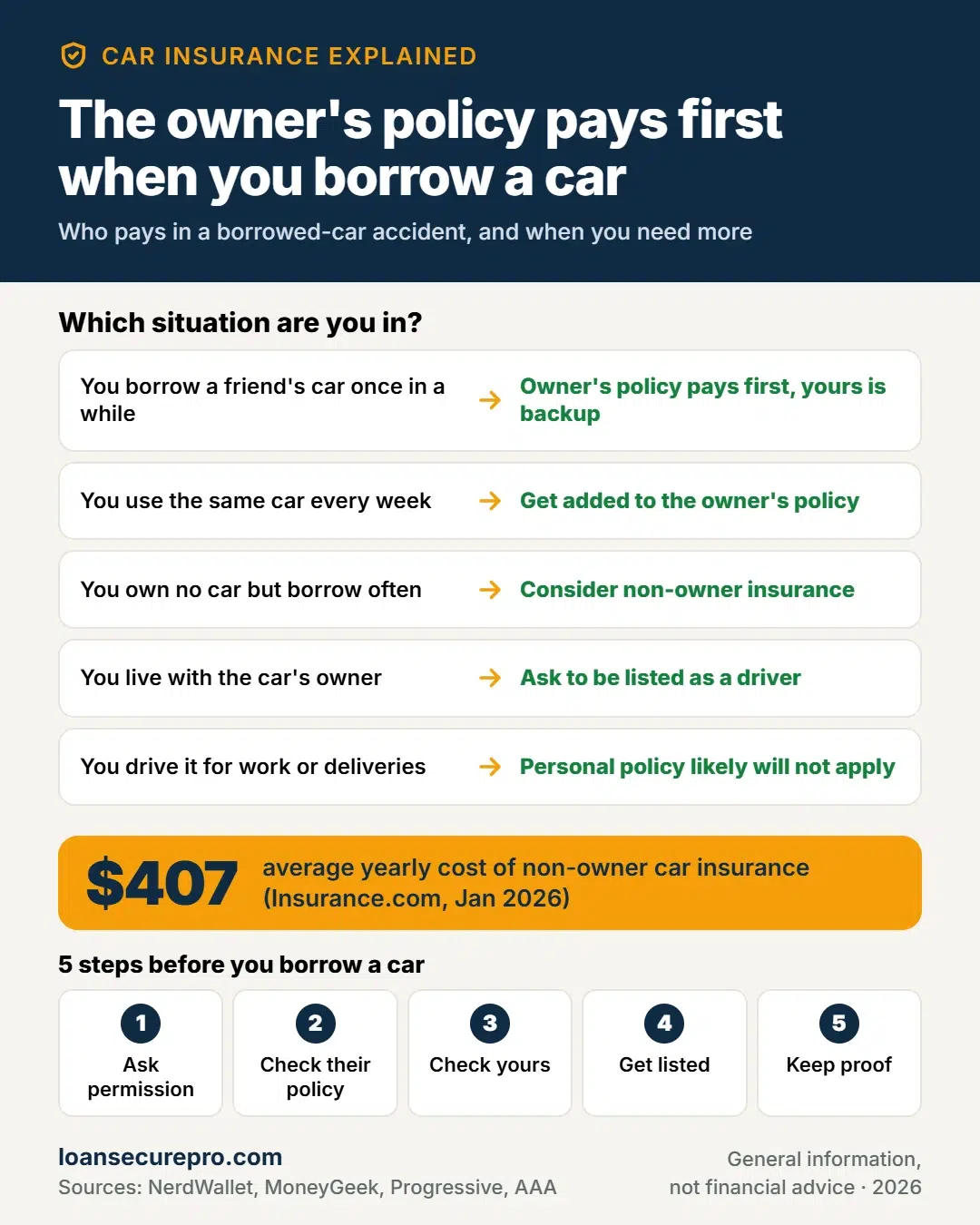
Usually your own policy is not the one that pays first. Car insurance generally follows the car, so the owner’s policy responds when you drive with permission. Your policy is typically secondary and may add liability coverage if the owner’s limits run out. It does not normally pay to repair the borrowed car, because that falls to the owner’s collision coverage. Occasional borrowing is fine, but regular use, unlisted household members, business driving and excluded drivers are not covered. If you own no car and borrow often, a non-owner policy averages about $407 a year.
In short: the owner’s policy pays first, yours is the backup, and the real risk is the gap between the owner’s limits and a serious crash.
That gap is where people get hurt financially. A permissive-use rule that works for a fender bender can leave you personally exposed after an injury crash, especially if the owner carries only state minimum limits.
This guide is for US drivers who borrow cars, lend them, or share a household vehicle. It shows who pays in each situation, when permission still does not protect you, and works through the dollar math on a coverage gap and on a non-owner policy.
Key takeaways
- Car insurance generally follows the car, not the driver, so the owner’s policy usually pays first when you borrow with permission.
- Your own policy is typically secondary, and it matters most when the owner’s liability limits run out.
- Damage to the borrowed car is normally paid by the owner’s collision coverage, and it can raise the owner’s rates.
- Regular use, household members, business driving and excluded drivers fall outside occasional permissive use.
- A borrower cannot pass permission along, so a friend you hand the keys to may not be covered.
- Non-owner insurance averages about $407 a year (Insurance.com, January 2026) and covers liability only.
- Asking before you drive costs nothing, and asking to be listed fixes most gaps.
In this guide
- Who pays when you drive a borrowed car
- What each policy covers
- When coverage does not apply
- Worked example: the coverage gap
- Worked example: is a non-owner policy worth it
- How to borrow a car safely, step by step
- Borrowing mistakes to avoid
- Where state and insurer rules differ
- Honest limits of this guide
- When to talk to a professional
- Frequently asked questions
Who pays when you drive a borrowed car
NerdWallet’s guide says that in general, car insurance follows the car, not the driver. AAA says the same: if the owner has insurance, that policy usually applies even when someone else is driving, and the borrower’s policy is secondary.
Secondary means your policy steps in only when the owner’s coverage cannot fully cover the damage. The table shows how that plays out in common situations.
| Situation | Pays first | Your policy’s role |
|---|---|---|
| You borrow a friend’s car with permission and cause a crash | The owner’s liability coverage | Backup if the owner’s limits run out |
| You damage the borrowed car | The owner’s collision coverage, if they carry it | Usually none for the car itself |
| A friend crashes your car | Your policy, so your rates may rise | You are the owner, so yours is primary |
| The owner has no insurance | Unclear; you may be personally liable | May help with liability, depending on your policy |
| You take the car without permission | Often the driver’s own insurer, if anyone | May be asked to respond |
| You rent a car for personal use | Your own auto policy generally applies, per NerdWallet | Primary for you |
The practical point is that being named on a policy and having a policy that applies are different things. The first is about you, and the second is about the car you are in.
What each policy covers
The coverages that matter are liability, collision and comprehensive. MoneyGeek explains that liability pays for injuries and property damage you cause to others, with no deductible, while collision pays for damage to the borrowed car regardless of fault and comprehensive covers theft or vandalism.
| Coverage | Owner’s policy | Your policy | Non-owner policy |
|---|---|---|---|
| Liability (injuries and damage to others) | Pays first | Often secondary | Secondary |
| Collision (repair the car you drive) | Pays, if the owner has it | Usually does not apply | Not included |
| Comprehensive (theft, vandalism, weather) | Pays, if the owner has it | Usually does not apply | Not included |
| Uninsured motorist and medical | Depends on the owner’s policy | Depends on your policy wording | Sometimes available |
The collision column is the one that surprises people. If the owner has no collision coverage, nobody’s insurer pays to fix the car, and the owner may look to you for the repair. Our guide to what collision car insurance covers explains how that coverage works.
A claim also has a cost for the owner. NerdWallet notes that when the owner’s insurer pays, the owner’s rates likely rise, and your own policy’s rates may change too if both insurers share the cost. That is a good reason to treat a borrowed car with extra care.
When coverage does not apply
Permission is the starting point, not a guarantee. MoneyGeek puts it plainly: permission does not guarantee coverage. Five situations commonly fall outside the owner’s policy.
Regular use. Permissive use is meant for occasional borrowing. If you drive the same car every week, or use it as a backup, the insurer may expect you to be listed. AAA advises adding regular drivers to the owner’s policy.
Household members. Anyone living with the owner generally needs to be listed. MoneyGeek says unlisted household members typically have no coverage, and Progressive says a non-listed household driver may be denied coverage after a crash.
Passing the keys on. AAA says a borrower cannot pass permission to someone else. If a teen lets a friend drive the family car, coverage likely will not apply.
Business use. A personal policy is unlikely to cover deliveries, rideshare or other paid driving. Our guide on temporary car insurance for a borrowed car covers short-term options when personal cover will not fit.
Excluded drivers and misuse. NerdWallet notes that drivers the owner has excluded are not covered, and AAA says coverage may be denied if the borrower drives negligently or criminally.
Worked example: the coverage gap
The biggest financial risk of borrowing is not the fender bender. It is a serious injury crash where damages exceed the owner’s limit.
MoneyGeek notes that the most common state minimum is $25,000 per person and $50,000 per accident, so a borrowed car with minimum limits is the typical case. A single hospital stay can pass that figure quickly.
This is where your own policy or a non-owner policy matters. Either one can respond to the $100,000 above, up to its own limit, because secondary liability coverage sits behind the owner’s.
If you own a car, ask your insurer whether your liability coverage extends to cars you borrow. Some personal auto policies do for occasional use, but the wording differs, so get the answer in writing.
Worked example: is a non-owner policy worth it
If you do not own a car but borrow often, what non-owner car insurance is is worth understanding. InsuranceQuotes.com describes it as a liability-only policy that follows the driver and usually acts as secondary coverage after the owner’s policy.
Credit Karma cites an earlier Insurance.com average of about $325 a year, and MoneyGeek estimates $200 to $500 a year. Treat all of these as ranges, since your price depends on your record, state and limits.
A non-owner policy does not cover damage to the car you drive, and rental car damage is generally excluded unless you buy a waiver or have card coverage. It also requires that you do not own a vehicle and do not have regular access to one.
| How you use other people’s cars | Best fit |
|---|---|
| A few times a year, owner insured | The owner’s policy, plus ask before you drive |
| Every week, same car | Get added to the owner’s policy as a driver |
| You own no car and borrow or rent often | Non-owner policy |
| You need an SR-22 and own no car | Non-owner SR-22 policy |
| One trip in a borrowed car | Short-term cover; see the temporary insurance guide above |
How to borrow a car safely, step by step
- Ask for clear permission. Get a yes from the owner before you drive, and confirm for how long.
- Confirm the car is insured. Ask the owner to show current proof of insurance and keep a photo of it.
- Ask about limits and collision. Find out the liability limits and whether the owner carries collision and comprehensive.
- Check your own policy. Ask your insurer whether your liability extends to non-owned cars and what it excludes.
- Check who else may drive. Do not hand the keys to anyone else, since permission does not pass on.
- Get listed if you drive it often. Ask the owner to add you as a driver instead of relying on goodwill.
- Consider a non-owner policy. If you own no car and borrow regularly, price one against your use.
- If something happens, report it. Tell the owner and both insurers promptly, and take photos and the other driver’s details.
Information to have ready: the owner’s name and insurer, the policy number from their proof of insurance, the car’s year and model, and your own policy number.
If you are the owner, the same steps work in reverse. NerdWallet advises confirming you have collision coverage, adding regular borrowers such as roommates, and judging whether the person drives safely before you agree.
Borrowing mistakes to avoid
Most borrowing problems come from assumptions, not bad luck. These four come up repeatedly.
Assuming your policy follows you. Your policy is usually the backup, not the first payer, and it rarely repairs the borrowed car.
Lending to an uninsured friend. NerdWallet notes that if the borrower has no insurance, the friend could be sued for amounts beyond your limits, and you might be sued too because your car was involved.
Letting a friend lend it on. Permission does not pass along. The second borrower may have no coverage at all.
Skipping the household list. A roommate or relative who drives your car often should be on the policy. An unlisted household driver is one of the most common reasons for a denied claim.
Do
- Get permission and proof of insurance
- Check liability limits and collision coverage
- Get listed if you drive the car often
- Tell your insurer about regular borrowers
- Photograph the car before and after
Don’t
- Hand the keys to a third person
- Use a borrowed car for paid work
- Assume a verbal yes covers everything
- Lend to a driver who has been excluded
- Skip reporting a minor accident
Where state and insurer rules differ
Rules about permissive use and who pays first are set by state law and each insurer’s policy wording, so the details differ by location.
Minimum limits. MoneyGeek says the most common state minimum is $25,000 per person and $50,000 per accident, and Florida requires no bodily injury coverage. A lower minimum means a bigger gap.
Penalties for no insurance. MoneyGeek reports penalties for driving uninsured ranging from $25 fines in New Hampshire to more than $1,500 in New York.
Household rules. Whether household members must be listed, and whether an insurer adds adults automatically, varies by company. NerdWallet notes that some insurers add adult household members automatically.
Borrowing frequency. Insurers set their own definition of occasional. MoneyGeek cites a rough threshold of 12 times a year but words it inconsistently, so do not rely on a number without asking.
Honest limits of this guide
This guide explains how borrowed-car coverage generally works. It cannot tell you what your policy says, since wording, state law and the facts of a crash decide who pays.
The cost figures are published averages from Insurance.com, NerdWallet and MoneyGeek, which use different driver profiles. They are not quotes. We did not request quotes from any insurer.
NerdWallet’s guide on car versus driver was last updated in 2022 and AAA’s in 2023, so we used them only for principles that change slowly. Sources disagree on some details, such as which policy pays first, so we flagged that where it matters.
When to talk to a professional
Call your insurer or a licensed agent before you borrow a car for more than a one-off trip, and ask for any answer in writing. They can tell you whether your liability extends to borrowed cars and what a non-owner policy would cost.
After a serious crash, talk to an attorney before accepting blame or signing anything, especially if injuries are involved. Contact your state Department of Insurance if a claim is denied and you think it should have been paid.
Disclaimer: this article is general information, not insurance, legal or financial advice. Coverage and prices depend on your policy, your state and your insurer. Confirm details with a licensed professional before relying on them.
Frequently asked questions
Can I drive someone else’s car with my insurance?
You can drive a borrowed car with the owner’s permission, but the owner’s insurance usually applies first. Your own policy is typically secondary and may add liability coverage if the owner’s limits are exceeded. It does not normally pay to repair the borrowed car. Check your policy wording to see how it treats non-owned cars.
Does car insurance follow the car or the driver?
In general it follows the car. NerdWallet and AAA both say that if the owner has insurance, that policy usually applies even when someone else drives with permission. The driver’s own policy may help as secondary coverage. Details vary by state and insurer, so treat this as the starting rule, not a guarantee.
What if I crash my friend’s car?
The owner’s liability coverage pays for the other party’s injuries and damage, up to its limits, and the owner’s collision coverage pays to repair the car if they carry it. The owner’s rates may rise. Your own insurer may help if the owner’s limits run out. Report it to both insurers promptly.
Will my insurance rates go up if I crash a borrowed car?
Usually the owner’s rates are affected first, because their insurer pays. NerdWallet says that when costs are shared between two insurers, both policyholders’ rates likely increase. Your own premium can also change if your insurer pays something or reviews your driving record, so the effect is not limited to the owner.
Do I need my own insurance to borrow a car?
Not for occasional use if the owner’s car is insured and you have permission. MoneyGeek says you generally do not need your own policy in that case. But you could be personally liable for damages above the owner’s limits, so having your own cover or a non-owner policy is safer if you borrow often.
How much does non-owner car insurance cost?
InsuranceQuotes.com cites an Insurance.com average of $407 a year as of January 2026. Credit Karma cites about $325 from an earlier Insurance.com figure, and MoneyGeek estimates $200 to $500. Your price depends on your driving record, state, limits and how often you drive, so get quotes before you decide.
Can a friend drive my car if they are not on my policy?
Usually yes for occasional use with your permission, since permissive use is a standard part of many policies. Progressive says anyone who drives regularly should be listed. A household member who is not listed may be denied coverage, and a friend you excluded is not covered at all.
What if my friend lets someone else drive my car?
Coverage may not apply. AAA says a borrower cannot pass permission to someone else, so a second driver you never approved could be outside your policy. Tell borrowers clearly that only they may drive, and remember that you could still face claims if your car is involved in a crash.
Does my insurance cover a rental car?
Generally your own auto policy applies to a personal rental, according to NerdWallet, so you may not need the rental company’s extra coverage. If you only have liability, damage to the rental may not be covered. Check your policy and any credit card benefit before you decline the rental company’s waiver.
Is a non-owner policy the same as being added to someone’s policy?
No. A non-owner policy is your own liability policy that follows you and is usually secondary. Being added to the owner’s policy makes you a listed driver on that car and is often better if you use one car regularly. MoneyGeek estimates listed-driver costs at $150 to $1,200 a year.
The bottom line
When you drive someone else’s car with permission, their insurance generally pays first and yours is the backup. The risk is the gap: owner limits can be low, collision may be missing, and some situations fall outside permission entirely.
Before your next borrow, ask the owner for proof of insurance and their limits, call your insurer to ask about non-owned cars, and decide whether you need to be listed or buy a non-owner policy. A five-minute call is cheap compared with an unpaid bill.
Sources
- NerdWallet: Does car insurance cover the car or the driver? (accessed Oct 31, 2026)
- NerdWallet: Why you should be careful when lending out your car (updated March 16, 2026) (accessed Oct 31, 2026)
- MoneyGeek: Can you drive someone else’s car without insurance? (updated Oct 1, 2026) (accessed Oct 31, 2026)
- Progressive: Does car insurance cover the car or driver? (accessed Oct 31, 2026)
- AAA: Do you need insurance to drive someone else’s car? (Oct 10, 2023) (accessed Oct 31, 2026)
- Credit Karma: How non-owner car insurance works (updated Nov 20, 2025) (accessed Oct 31, 2026)
- InsuranceQuotes.com: Non-owner car insurance guide (Jan 2026) (accessed Oct 31, 2026)