Do Car Insurance Rates Go Down With Age? What Changes at Each Stage
Written by Rakib Sarwar, 15 years in banking and lending · Last updated: October 31, 2026
Why trust this guide: every rate figure below comes from NerdWallet’s 2026 analysis, Progressive’s published rate table, MoneyGeek (March 2026) or The Zebra’s senior rate study. We do not sell insurance.
Disclosure: this page may carry ads or links to insurance partners. They do not affect what we write, and we never recommend a policy because of a commission.
Every birthday brings a small hope that the renewal notice will be lower. For car insurance, that hope is justified in some decades and misplaced in others, because age moves your rate in a pattern that is steep at first, flat in the middle and upward at the end.
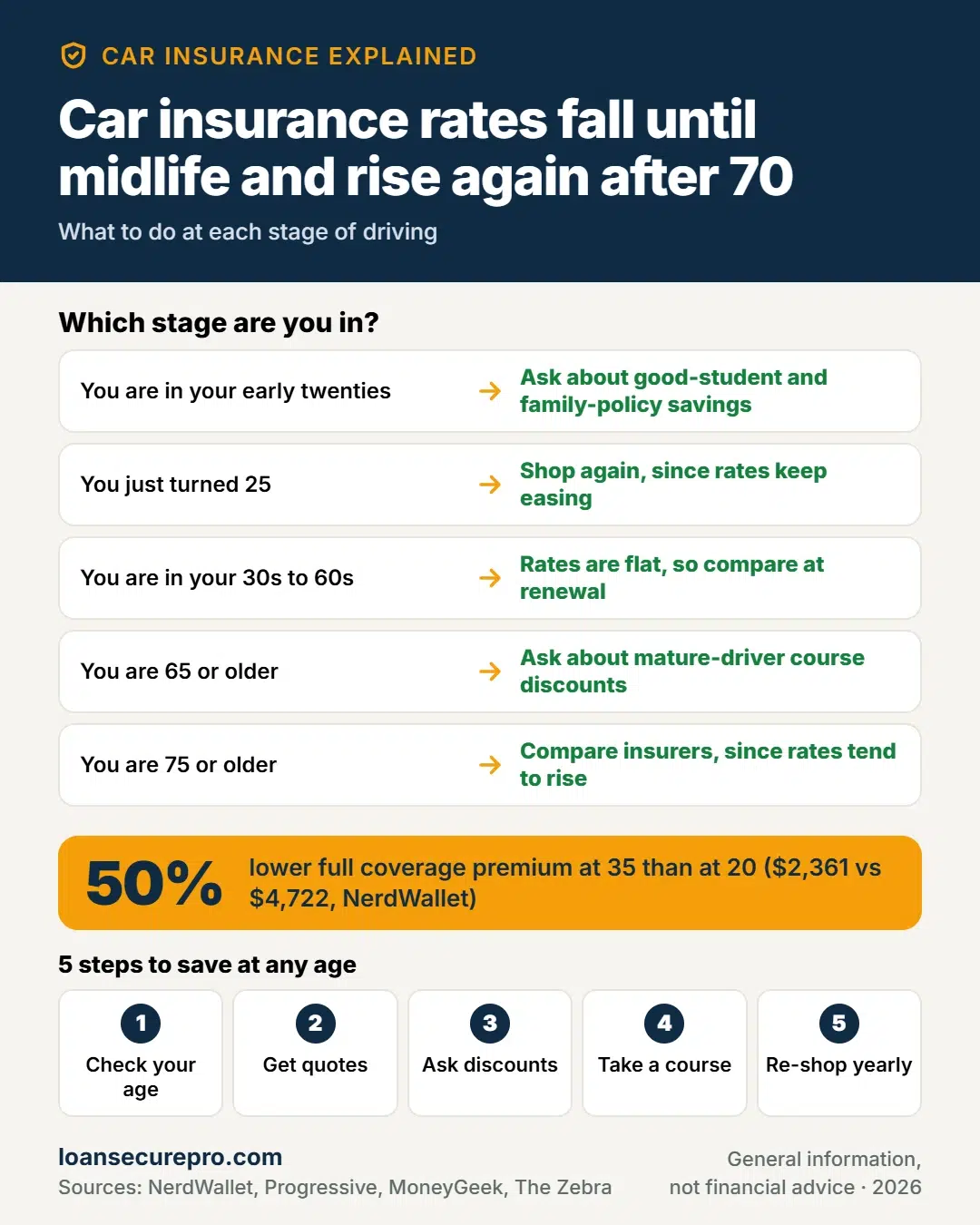
Yes, car insurance rates generally go down with age, but only up to a point. NerdWallet’s 2026 analysis shows full coverage falling from $4,722 a year at age 20 to $2,361 at age 35, a 50 percent drop. Rates then drift down slowly to about $2,029 at age 60. After 70 they rise again, to $2,160 at age 70 in NerdWallet’s data, and further after 75. Your record, credit, state and insurer can outweigh age, and a few states do not allow age as a rating factor at all, so comparing quotes at each stage matters.
In short: expect the biggest drops in your twenties, flat rates through midlife and higher rates in later years, and shop around at each milestone.
The pattern exists because insurers price on claims data. New drivers crash far more often per mile, and older drivers face higher injury severity, while the long stretch in between is the cheapest to insure.
This guide is for US drivers at any age. It combines figures from four sources, shows where they disagree, works through the dollar value of each age milestone, and explains how to save at every stage, including the states where age is not allowed in pricing.

Key takeaways
- Full coverage falls from $4,722 at age 20 to $2,361 at age 35, a 50 percent drop, according to NerdWallet.
- Progressive says rates drop about 10 percent at 19, 5 percent at 20 and 6 percent at 21, then level off.
- Rates stay roughly flat from the mid-thirties into the sixties, and fall a little more in some data.
- After 70 premiums rise: The Zebra puts the increase at about 32 percent between ages 60 and 80.
- California, Hawaii and Massachusetts do not allow age as a rating factor, per The Zebra.
- An accident before 25 can stop the age discount from showing up on your bill.
- Shopping quotes at 25, at 65 and at 75 is more reliable than waiting for a birthday discount.
In this guide
- Average car insurance rates by age
- Why age changes your rate
- Young drivers: when rates drop
- Older drivers: when rates rise
- Worked example: what each age milestone is worth
- How to save at any age, step by step
- Age-related mistakes to avoid
- Where state and insurer rules differ
- Honest limits of this guide
- When to talk to a professional
- Frequently asked questions
Average car insurance rates by age
NerdWallet’s 2026 analysis gives the clearest picture for a good driver. The sample is a clean record, good credit, a 2023 Toyota Camry LE, 12,000 miles a year and $1,000 deductibles.
| Age | Full coverage per year | Minimum coverage per year |
|---|---|---|
| 20 | $4,722 | $1,333 |
| 30 | $2,435 | $664 |
| 35 | $2,361 | $648 |
| 40 | $2,289 | $632 |
| 50 | $2,118 | $594 |
| 60 | $2,029 | $588 |
| 70 | $2,160 | $658 |
The curve is steepest between 20 and 30, nearly flat through the forties and fifties, lowest around 60, then turns up at 70. NerdWallet does not publish figures for ages 16 to 19, 25, 45, 55, 65 or 75 and older.
Other sources fill some of the gaps, with different methods. The table compares them, so treat each as a range, not a promise.
| Source | What it shows |
|---|---|
| MoneyGeek (Mar 2026) | Teens pay $6,262 to $7,962 a year for full coverage. Drivers 65 and older pay about $157 a month, roughly $31 more than ages 26 to 64. |
| Progressive (2023 to 2024 data) | Monthly averages fall from $247.28 at 17 and under to $168.86 at 25 to 29 and $122.26 at 65 to 74, then rise to $127.96 at 75 and over. |
| The Zebra | $1,934 at 60, $2,089 at 70, $2,545 at 80 and $2,830 at 89, about 32 percent more between 60 and 80. |
The sources do not match exactly because each uses a different car, driver profile and rate filing. What they agree on is the shape: high when young, low in midlife and higher again at the end.
Why age changes your rate
Insurers price on expected claims, and claims differ by age. The main drivers are experience, risk and the cost of injuries.
New drivers. MoneyGeek cites National Safety Council data showing that 16 to 19-year-olds crash nearly four times as often per mile as drivers 20 and older.
Experienced drivers. Progressive’s data shows premiums falling significantly from 19 to 34 and then stabilizing, which fits the idea that more driving experience means fewer claims. Discounts you collect over time, such as bundling, can add to the effect.
Older drivers. The Zebra says seniors are more likely to suffer serious injuries, which raises claim payouts, and that older drivers are more often involved in intersection and left-turn crashes. It notes an uptick in fatal crashes per 100,000 licensed drivers after age 74, though it sees no increase across all accidents.
That last point matters. Rates for older drivers follow group claim trends, so a careful 78-year-old can still pay more than a careful 55-year-old.
Young drivers: when rates drop
Progressive says average premiums tend to decrease significantly from age 19 to 34, then stabilize. Its table shows rates dropping about 10 percent at 19, 5 percent at 20 and another 6 percent at 21.
| Age | What typically happens | What to do |
|---|---|---|
| 16 to 18 | Highest rates, from about $6,988 to $7,962 (MoneyGeek) | Stay on a parent’s policy and ask about teen discounts |
| 19 to 21 | Drops of about 10, 5 and 6 percent (Progressive) | Keep a clean record and ask for a good-student discount |
| 22 to 24 | Rates keep easing if the record is clean | Re-shop each renewal |
| 25 | Progressive’s average is $168.86 a month for ages 25 to 29 | Get fresh quotes from several insurers |
| 26 to 34 | Gradual declines, from $2,435 at 30 (NerdWallet) | Bundle policies and compare |
Progressive notes that discounts help along the way, such as a good student discount for full-time students under 23 with a B average.
For more on the youngest drivers, see our guide to car insurance for teens.
Older drivers: when rates rise
Progressive says rates drop and stay level until the mid-70s. Its table shows 55 to 64 at $128.60 a month, down 9 percent, and 65 to 74 at $122.26, down 5 percent. At 75 and older the average rises to $127.96, up 5 percent.
The Zebra’s study of Honda Accord profiles finds a steeper rise, from $1,934 at 60 to $2,545 at 80, about 32 percent. MoneyGeek puts drivers 65 and older at about $31 more a month than ages 26 to 64.
These figures differ because the studies differ, but the direction is the same. The Zebra says seniors can pay more even with a good record, citing declining physical and cognitive abilities and claims trends.
Savings exist, though. Progressive says some states require mature-driver discounts for people who complete a state-approved course, and low-mileage drivers can save with usage-based programs. Our guide to the best car insurance for seniors covers insurers worth comparing.
Worked example: what each age milestone is worth
Using NerdWallet’s full coverage figures, the dollar value of each stage is easy to see.
The first milestone is worth far more than all the others combined. A driver who stays clean from 20 to 35 cuts the bill in half, while the next 25 years take off about 14 percent.
The late-life rise is real but smaller. The Zebra’s $611 increase between 60 and 80 is about a quarter of the $2,361 saved between 20 and 35.
These numbers are examples, not quotes. The point is that shopping at 65 can save as much as the age change itself costs, which is why we recommend re-shopping at each milestone. Our guide on how to lower your car insurance premium explains the other levers.
How to save at any age, step by step
- Note your age milestone. Check whether you are near 25, 65 or 75, when quotes tend to change.
- Pull your current policy. Note your limits, deductibles, mileage and listed drivers.
- Get three to five quotes. Request identical limits and deductibles from each insurer.
- Ask for age-based discounts. Examples include good student, mature driver course and low-mileage discounts.
- Take an approved course if offered. Confirm with your insurer that it qualifies in your state before paying.
- Update your mileage. Report lower annual mileage if you drive less, or ask about pay-per-mile rates.
- Keep the record clean. Avoid tickets and at-fault accidents, which can erase the age discount.
- Re-shop every year. Compare quotes a month before renewal and switch if the savings are clear.
Information to have ready: your declarations page, driver’s license numbers, vehicle identification numbers, annual mileage and the dates of any tickets or accidents.
Age-related mistakes to avoid
Age gives you a tailwind, but a few habits waste it. These four are common.
Waiting for a birthday discount. Insurers do not always apply age changes automatically in your favor. Ask for a review and get fresh quotes.
Staying with one insurer for decades. Rates for older drivers vary widely by company, so loyalty can cost more than the age effect itself.
Dropping coverage to offset a rise. Cutting liability to save money exposes your savings. Adjust deductibles or mileage instead.
Ignoring your record. A ticket or accident at 24 can cancel the rate drop that age 25 would have brought.
Do
- Shop at ages 25, 65 and 75
- Ask about course and student discounts
- Report lower mileage when it drops
- Compare identical coverage
- Keep records clean before milestones
Don’t
- Assume a birthday lowers your bill
- Cut liability limits to save money
- Take a course before checking it qualifies
- Stay with one insurer out of habit
- Hide drivers or mileage
Where state and insurer rules differ
Age matters less in some places, and each insurer weighs it differently.
States that limit age. The Zebra says California, Hawaii and Massachusetts do not allow age as a rating factor. In those states the age curve in this guide largely does not apply.
Flat and steep states. The Zebra reports Maine and North Carolina show almost no age-related change, while Ohio shows a 53 percent increase, from $1,377 to $2,103, for older drivers.
Mature-driver courses. Progressive says some states require insurers to offer a discount for completing a state-approved course. Whether yours does, and how much it is, varies.
Insurer differences. Each company sets its own age rating. MoneyGeek notes a $5,004 yearly gap between the cheapest and costliest insurer for a 16-year-old, so comparing matters at every age.
Honest limits of this guide
This guide describes averages. Your own rate depends on your record, credit, vehicle, state and insurer, so it may sit far from the averages shown.
The four sources use different driver profiles, cars and years, and some pages are dated or internally inconsistent, which is why we flagged them. The Zebra’s page carries no date, so treat its senior figures as a recent but undated sample.
The 65-year-old example uses assumed premiums and an assumed 5 percent discount. We did not request quotes from any insurer.
When to talk to a professional
A licensed independent agent can quote several insurers at once and tell you which age-based discounts apply in your state. Ask one at each milestone, especially after 65.
Contact your state Department of Insurance if you think you were rated unfairly, particularly in a state that does not allow age as a rating factor.
Disclaimer: this article is general information, not insurance, legal or financial advice. Coverage and prices depend on your policy, your state and your insurer. Confirm details with a licensed professional before relying on them.
Frequently asked questions
At what age does car insurance go down the most?
The biggest drops come between the late teens and the mid-thirties. NerdWallet shows full coverage falling from $4,722 at 20 to $2,361 at 35, and Progressive reports drops of about 10 percent at 19, 5 percent at 20 and 6 percent at 21. After that, rates fall more slowly.
Does car insurance really drop at 25?
Often, but not automatically. Progressive’s data shows rates falling through the early twenties and averaging $168.86 a month at 25 to 29, but warns an accident before 25 may stop the drop. Get fresh quotes around your birthday, because savings come from a clean record plus shopping.
When do car insurance rates start to rise for older drivers?
Usually after 70. NerdWallet shows $2,160 at age 70 versus $2,029 at 60, and Progressive’s average rises at 75 and older. The Zebra reports about 32 percent more between 60 and 80. The size of the increase depends on your state, insurer and record.
Why is car insurance cheapest around age 60?
In NerdWallet’s data, $2,029 at age 60 is the lowest full coverage average in its table. Progressive’s table shows its lowest monthly averages for ages 55 to 74. Individual rates still depend on your record and location.
Do any states not allow age to affect car insurance?
Yes. The Zebra says California, Hawaii and Massachusetts do not allow age as a rating factor. It also notes that Maine and North Carolina show almost no age-related change. In most other states insurers can use age, so check how your state regulates rating factors.
Can I lower my rate as a senior driver?
Yes. Compare quotes from several insurers, ask about mature-driver course discounts, and consider usage-based or pay-per-mile programs if you drive less. Progressive says some states require course discounts. Confirm that a course qualifies before you pay, and keep a clean driving record.
How much more do teens pay than adults?
A lot more. MoneyGeek reports full coverage from $6,262 at 19 to $7,962 at 16, compared with $1,506 a year for ages 26 to 64. The gap reflects higher crash rates for new drivers. Staying on a parent’s policy and asking about discounts usually costs less than a separate teen policy.
Will a ticket cancel my age discount?
It can offset it. Progressive notes that an accident before 25 may stop your rate from dropping. The age effect is real, but a clean record is what lets you keep it. Ask your insurer how long a violation affects your rate.
Is it worth shopping for car insurance every year?
Yes, at any age. Rates for the same driver vary widely between insurers, and the right company can change as your age, car and record change. Compare identical coverage a month before renewal, and re-shop at milestones such as 25, 65 and 75.
Does driving less lower the rate for older drivers?
It can. Report your lower annual mileage to your insurer, and ask about usage-based or pay-per-mile programs. The Zebra notes that limited driving does not always offset higher accident severity, so the saving may be modest, but pay-per-mile is often worth a quote.
The bottom line
Car insurance rates do go down with age, mostly between 20 and 35, stay near their lowest in midlife and rise after 70. A clean record, good credit and regular shopping can matter as much as the number of candles on your cake.
This month, check where you sit on the age curve, get three to five quotes with identical coverage, and ask for every age-based discount you qualify for. Then set a reminder to repeat it before your next renewal.
Sources
- NerdWallet: Average cost of car insurance (2026 analysis) (accessed Oct 31, 2026)
- Progressive: What age does car insurance go down? (accessed Oct 31, 2026)
- MoneyGeek: Car insurance rates by age (updated March 24, 2026) (accessed Oct 31, 2026)
- The Zebra: Senior drivers and car insurance premiums (accessed Oct 31, 2026)