What Is Car Insurance Underwriting? How Insurers Decide Your Coverage and Rate
Written by Rakib Sarwar, 15 years in banking and lending · Last updated: October 31, 2026
Why trust this guide: every rule and figure below comes from the Alabama Department of Insurance, NAIC, Experian, ValuePenguin, CarInsurance.com, CheapInsurance.com (via KVIA) or the Illinois Department of Insurance, and we name the source each time. We do not sell insurance.
Disclosure: this page may carry ads or links to insurance partners. They do not affect what we write, and we never recommend a policy because of a commission.
You ask for a quote, answer a dozen questions, and a price appears in seconds. Behind that price sits a decision you never see: whether the insurer will take you on at all, and in which risk group it will put you.
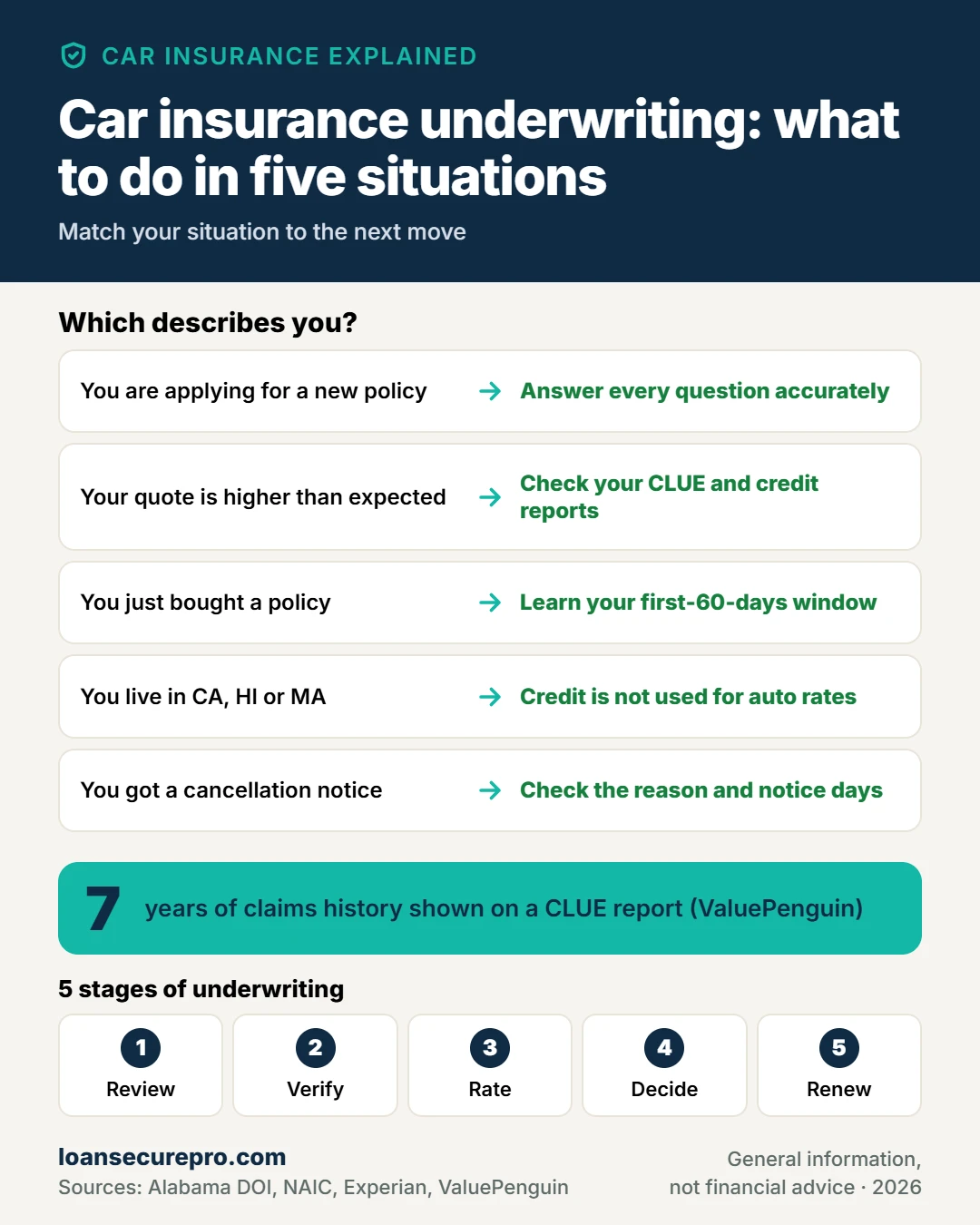
Car insurance underwriting is the process an insurer uses to assess the risk of insuring you, group you with similar risks and decide whether to accept your application. The Alabama Department of Insurance says price then comes from rating, which sets a premium based on the expected cost of your claims. Underwriters review your driving record, claims history, garaging address, vehicle, mileage and prior coverage, and in most states credit-based scores too. In most states a new policy can be cancelled for almost any reason during an initial window of about 60 days.
In short: underwriting decides whether and where you fit, rating sets the price, and a clean, accurate application is the cheapest way to get through both.
Most explanations stop at a list of factors. What matters more is what happens after the quote: which reports the insurer pulls, how credit is used, what a mistake on your application can cost you, and how long the insurer can still change its mind.
This guide is for US drivers buying, renewing or switching a policy. It separates underwriting from rating, compares the main reports insurers use, lists the states that restrict credit, works through three dated examples, and shows where the sources disagree.

Key takeaways
- Underwriting assesses risk and decides whether to accept you, and rating sets the price (Alabama Department of Insurance).
- A CLUE report shows seven years of claims history, and you are entitled to a free copy every year (ValuePenguin, Jun 2026).
- Motor vehicle records generally cover three years, though this varies by state (ValuePenguin).
- California, Hawaii and Massachusetts bar credit in auto underwriting or rating, and four more states limit it (Experian).
- CarInsurance.com says new policies typically have a 60-day underwriting period, with 90 days in seven states.
- CheapInsurance.com lists 60 days in 48 states, 90 in Florida and 45 in Maryland, so the two sources disagree.
- Lying on an application is grounds for cancellation in every state, according to CarInsurance.com.
In this guide
- Underwriting and rating: what each one does
- What underwriters look at
- The reports behind the decision
- Credit-based insurance scores and state limits
- The first 60 days and cancellation rules
- Worked examples: look-back, window and notice dates
- What you can do about your risk profile
- How to prepare, step by step
- Mistakes to avoid
- Where state and insurer rules differ
- Honest limits of this guide
- When to talk to a professional
- Frequently asked questions
Underwriting and rating: what each one does
The Alabama Department of Insurance says two factors determine what you pay for auto insurance: underwriting and rating. They happen in order, and they answer different questions.
| Stage | The question it answers | What the regulator says |
|---|---|---|
| Underwriting | Will the insurer take this risk, and in which group? | Insurers assess the risk of an applicant, group the applicant with similar risks and decide whether to accept the application |
| Rating | What should this risk cost? | The insurer sets a price reflecting its expected cost of covering the applicant’s potential claims |
In practice, the three possible outcomes are acceptance at a standard price, acceptance in a higher-risk group at a higher price, or a decline. The Alabama page describes the grouping and the accept-or-decline decision. It does not give percentages for how often each outcome happens, and we found no source that does.
Underwriting does not always end when you buy. In the first weeks of a new policy, insurers can cancel for reasons they discover after the sale, and a later section covers the rules.
What underwriters look at
The Alabama Department of Insurance lists the factors insurers may use. Not every insurer uses every one, and states limit some of them.
| Factor | What it covers | Why it matters |
|---|---|---|
| Driving record | Accidents and violations for any covered driver, over the preceding 3 to 5 years | Recent incidents signal future claims |
| Territory | The address where the car is garaged | Claims are higher in urban areas |
| Age and gender | Young men may pay more than young women; a small number of states bar gender | Claim rates differ by group |
| Marital status | Married policyholders generally have lower claim rates | A group-level statistic, not a verdict on you |
| Prior coverage | Past cancellation for non-payment and claims with a prior insurer | Shows payment and claims history |
| Vehicle use | Annual mileage and how far the car is driven | Higher mileage generally means higher premiums |
| Make and model | Vehicles with high claim frequency or cost | Can raise comprehensive and collision premiums |
| Lifestyle | Employment history | Long-term employment is associated with lower claims |
The Alabama page does not address credit information, so we cover it separately below. It also says not all states allow the same discounts, so your own list may be shorter or longer.
Garaging address deserves special care. CheapInsurance.com lists an incorrect garaging address among the problems that can trigger a cancellation, which we cover in the first-60-days section.
The reports behind the decision
Insurers do not rely only on what you tell them. They check your answers against records. The two best known are the motor vehicle record, usually called an MVR, and the CLUE report.
| Report | Focus | How far back | What it shows |
|---|---|---|---|
| MVR | The driver | Generally three years, varies by state | Traffic citations, driving record points and DUI convictions |
| CLUE (auto) | The vehicle and claims | Seven years | Insurer name, claim number, date and type of loss, amount paid, and vehicle details |
ValuePenguin (updated June 30, 2026) says CLUE stands for Comprehensive Loss Underwriting Exchange and defines the report as the seven-year history of loss for a person and a property. If you filed no claims in that period, or your insurer did not report, the report can be blank.
The same article says you are entitled to a free copy of your own CLUE report every year, and it names LexisNexis as the company that offers the reports. It does not describe how to dispute an error, so if you find one, ask the report company and your insurer what their process is.
Our guide on the best car insurance for high-risk drivers explains what to do when these records push you into a higher-priced group.
Credit-based insurance scores and state limits
The NAIC, the association of state insurance regulators, says a credit-based insurance score is based partly or entirely on information from your credit history. Insurers use it mainly in underwriting and rating to estimate the likelihood of a future claim.
It is not the same as the score a lender sees. According to the NAIC, traditional credit scores predict loan repayment, while insurance scores predict the likelihood of an insurance claim and may weigh credit factors differently. The NAIC also says they are usually one of several inputs.
The rules differ sharply by state. Experian (March 18, 2025) summarises seven states:
| State | What auto insurers may do with credit |
|---|---|
| California | May not use credit-based scores or credit history for underwriting or rating |
| Hawaii | May not use credit ratings in setting underwriting standards or rating plans |
| Massachusetts | May not use credit information to set rates, underwrite new policies or renew policies |
| Maryland | May use credit to help set the rate on a new policy, but not to deny, cancel, refuse to renew or raise premiums at renewal |
| Michigan | May not use credit to deny, cancel, refuse to renew or set rates; it may still affect installment payment options |
| Oregon | May not cancel or refuse to renew because of credit; may consider certain credit information when first offering a policy |
| Utah | Credit may be used in initial underwriting but not as the sole factor; after 60 days it cannot be used to cancel or refuse renewal, and it may only give discounts |
The NAIC adds that many states require insurers to tell you when credit information played a role in an adverse decision, and that you generally have the right to review your credit report and dispute inaccuracies. In most states, insurers cannot rely on these scores alone to raise rates or to deny, cancel or refuse to renew a policy.
If credit is holding your price up, read car insurance for people with bad credit, and check your credit report for errors before you shop.
The first 60 days and cancellation rules
Underwriting does not always finish when you pay. CarInsurance.com (updated January 13, 2023) says new policies typically have a 60-day underwriting period, but the length varies by state. During it, insurers can cancel, and the required notice ranges from 10 to 60 days depending on the state.
The Illinois Department of Insurance puts it plainly: during the first 60 days of a new policy, your company may cancel for almost any reason. After that, it may cancel only for listed reasons.
| Source | How long is the window? |
|---|---|
| Illinois Department of Insurance | First 60 days; almost any reason |
| CarInsurance.com (Jan 2023) | Typically 60 days. 30 days in Washington, D.C. 90 days for auto in Florida, Kansas, Minnesota, New Hampshire, North Dakota, Ohio and South Carolina |
| CheapInsurance.com via KVIA (Dec 2025) | 60 days in 48 listed states, including Kansas, Minnesota, New Hampshire, North Dakota, Ohio and South Carolina. 90 days in Florida. 45 days in Maryland |
The two lists agree on Florida at 90 days but conflict on six states: Kansas, Minnesota, New Hampshire, North Dakota, Ohio and South Carolina. They were also published almost three years apart by different publishers. We cannot settle it, so confirm your own state’s rule with the state insurance department.
What can trigger a cancellation
CarInsurance.com says every state allows mid-term cancellation for non-payment and for material misrepresentation, meaning you lied about a material fact. It defines that as something the insurer would have priced differently or declined had it known.
CheapInsurance.com lists examples of problems found in the window: undisclosed drivers, an incorrect garaging address, false vehicle use such as ride-sharing, an adverse motor vehicle record discovered after binding, and undisclosed modifications. It also names discrepancies found through VIN, CLUE or credit checks.
After the window, Illinois allows cancellation only for listed reasons, including non-payment, misrepresentation or fraud, violating the policy terms, a license suspension in the past 12 months, and a substantial increase in risk. The Illinois notice must be mailed to your last known address and must explain the reason and your right to appeal.
Worked examples: look-back, window and notice dates
These examples apply the rules in the sources to dated scenarios. The dates are ours, and the rules differ by state.
The CLUE and MVR periods measure different things, which is why a claim can outlast a violation. Your state and each insurer set their own look-back, so use these as an outline only.
If a record check on March 10 shows a violation you did not disclose, the length of your state’s window decides whether the insurer can cancel for almost any reason or only for the listed ones.
These notice periods come from Illinois alone. CarInsurance.com says notice for non-payment is most commonly 10 days and generally 20 to 60 days for other reasons, so other states can give more time.
What you can do about your risk profile
You cannot change your age or address history, but several inputs are yours to manage. The Alabama regulator suggests lowering your risk profile, which may place you in a lower-risk group, and asking each company which discounts it offers.
| Action | What it affects | Source |
|---|---|---|
| Check your free annual CLUE report | Claims shown to insurers; fix wrong entries | ValuePenguin |
| Check your credit report | Errors or outdated items that can affect insurance outcomes | NAIC |
| Ask about each discount by name | Savings vary by company | Alabama Department of Insurance |
| Compare the total after discounts | Base premiums can mislead | Alabama Department of Insurance |
| Report mileage and use accurately | Mileage and business use affect price and eligibility | Alabama; CheapInsurance.com |
The Alabama list of discounts includes multiple vehicles, driver education, good student, safety and anti-theft devices, low mileage, good driver or renewal, auto and home packages, and dividends from mutual insurers. It adds that dividends are declared and paid after the policy period has expired.
Our guide on how to lower your car insurance premium goes through each discount and its trade-offs.
How to prepare, step by step
- List every driver and vehicle. Include household members who may drive, and note where each car is garaged overnight.
- Request your CLUE report. You are entitled to a free copy each year, and it shows seven years of claims.
- Check your credit report. Look for errors and outdated items, and dispute inaccuracies before you apply.
- Write down your driving history. Note accidents and violations from the last three to five years so your answers match the records.
- Estimate mileage and use honestly. Say whether you commute, deliver or ride-share, because false use can void a policy.
- Get several quotes on the same terms. Compare the total after discounts, not only the base premium.
- Ask about the underwriting window. Find out how long your state allows and what notice you would receive.
- Keep your records after you buy. Save the application, the declarations page and any notices in case of a dispute.
Information to have ready: driver’s licence numbers, VINs, the garaging address, current mileage, prior insurer and policy dates, and the details of any accident or violation in the last five years.

Mistakes to avoid
These mistakes cost drivers the most, because underwriting compares your answers with records the insurer can check.
Leaving a driver or use off the application. Material misrepresentation is grounds for cancellation in every state, according to CarInsurance.com.
Using an old address. An incorrect garaging address is one of the problems CheapInsurance.com lists as a cancellation trigger.
Assuming the quote is final. A quote is an offer based on your answers, and the insurer can adjust or cancel once records show something different.
Ignoring your own reports. Errors in a CLUE or credit report can raise your price, and you only find them if you look.
Do
- Disclose every driver and use
- Check your CLUE and credit reports
- Keep the garaging address current
- Compare totals after discounts
- Save every notice you receive
Don’t
- Hide drivers or business use
- Guess at mileage
- Assume a quote cannot change
- Ignore a notice from the insurer
- Cancel the old policy before the new one starts
Where state and insurer rules differ
Four things vary: the length of the underwriting window, the notice you must receive, what credit can be used for, and which rating factors are allowed.
The window. The sources we read disagree on the length in six states, as the table above shows. Illinois uses 60 days in its own guidance.
Notice. Illinois requires at least 10 days for non-payment and at least 30 days for any other reason. CarInsurance.com gives ranges of 10 to 60 days for notice during the underwriting period.
Credit and gender. California, Hawaii and Massachusetts bar credit in auto underwriting or rating, and Maryland, Michigan, Oregon and Utah limit it. The Alabama page adds that a small number of states prohibit gender in underwriting.
Discounts. The Alabama regulator warns that not all states allow the same discounts to be used.
Honest limits of this guide
This guide cannot tell you how your insurer will underwrite you. The sources span dates from January 2023 to June 2026, and rules change, especially on credit.
The two sources on the underwriting window disagree, and we could not settle it. We did not check each state’s statute or contact an insurer, and the Illinois rules apply only in Illinois.
We found no source with the share of applications declined or the size of credit’s effect on price, so we give none. Example dates are illustrations, not predictions, and the Experian summary covers seven states, not all of them.
When to talk to a professional
A licensed agent or broker can explain how an insurer will treat your record, which discounts apply and what your state’s underwriting window is. Ask them what the insurer would see on your CLUE and driving records before you apply.
If you believe a cancellation or nonrenewal broke your state’s rules, contact your state insurance department, which can explain your appeal rights. For a legal dispute over what a policy promised, speak with a licensed attorney in your state.
Disclaimer: this article is general information, not insurance, legal or financial advice. Coverage and rules depend on your policy, your state and your insurer. Confirm details with a licensed professional before relying on them.
Frequently asked questions
What is car insurance underwriting?
It is how an insurer assesses the risk of insuring you, groups you with similar risks and decides whether to accept your application, according to the Alabama Department of Insurance. Pricing is the next step, called rating, which sets a premium based on the expected cost of your claims.
What is the difference between underwriting and rating?
Underwriting decides whether the insurer will take the risk and which group you belong to. Rating then sets the price for that group, reflecting the insurer’s expected cost of covering your potential claims. The Alabama Department of Insurance names both as the two factors that determine what you pay.
What do car insurance underwriters look at?
Your driving record over the past three to five years, where the car is garaged, age and gender, marital status, prior coverage, mileage and use, the car’s make and model, and employment history. Many insurers also use credit-based insurance scores, except in states that restrict them.
What is a CLUE report?
A Comprehensive Loss Underwriting Exchange report shows the seven-year history of claims for a person and a property, including the insurer, claim number, date and type of loss and amount paid. ValuePenguin says you are entitled to a free copy of your own report every year.
How far back do insurers check my driving record?
A motor vehicle record generally covers three years, though it varies by state, according to ValuePenguin. The Alabama Department of Insurance says insurers may look at accidents and violations over the preceding three to five years. Claims history on a CLUE report goes back seven years.
Do insurers use my credit score?
Many do, in the form of a credit-based insurance score, which the NAIC says predicts claims rather than loan repayment. California, Hawaii and Massachusetts bar its use in auto underwriting or rating, and Maryland, Michigan, Oregon and Utah limit it. Check your state’s rule.
Can my insurer cancel my policy in the first 60 days?
Often yes. The Illinois Department of Insurance says that during the first 60 days of a new policy, the company may cancel for almost any reason. CarInsurance.com says the window typically lasts 60 days but varies by state, and that notice ranges from 10 to 60 days.
Why do sources disagree on how long the underwriting period is?
They draw on different dates and state rules. CarInsurance.com lists 90 days in seven states, while CheapInsurance.com lists 60 days in six of them and 90 in Florida. We cannot settle it, so ask your state insurance department or your agent for your own state’s rule.
What happens if I lie on my application?
Every state allows mid-term cancellation for material misrepresentation, meaning a lie about a fact the insurer would have priced differently or declined, according to CarInsurance.com. Examples include undisclosed drivers, a wrong garaging address and false vehicle use. You may then have to search for replacement coverage.
Can I fix an error that is raising my rate?
Often, if it is in a report. The NAIC says you can review your credit report and dispute inaccuracies, and ValuePenguin says you can get your CLUE report free each year. Ask the report company how to dispute an entry, then ask your insurer to rerun your quote.
The bottom line
Underwriting is the insurer’s decision about whether and where you fit, and rating turns that decision into a price. Both rest on records the insurer can check, so accurate answers protect you more than any trick for a lower quote.
This week, request your CLUE report and review your credit report, then write down every driver, car and use before you ask for quotes. After you buy, find out how long your state’s underwriting window lasts and keep every notice you receive.
Sources
- Alabama Department of Insurance: Auto insurance underwriting and rating (accessed Oct 31, 2026)
- NAIC: Credit-based insurance scores (updated Mar 19, 2026) (accessed Oct 31, 2026)
- Experian: States that restrict credit-based insurance scores (Mar 18, 2025) (accessed Oct 31, 2026)
- ValuePenguin: What is a CLUE insurance report? (updated Jun 30, 2026) (accessed Oct 31, 2026)
- CarInsurance.com: When and why your car insurer can cancel coverage (updated Jan 13, 2023) (accessed Oct 31, 2026)
- CheapInsurance.com via KVIA: Can your auto insurance policy be canceled in the first 60 days? (Dec 23, 2025) (accessed Oct 31, 2026)
- Illinois Department of Insurance: If your auto insurance policy is canceled (accessed Oct 31, 2026)