Does Car Insurance Cover Flood Damage? What Pays and What Doesn’t
Written by Rakib Sarwar, 15 years in banking and lending · Last updated: October 31, 2026
Why trust this guide: every coverage rule and figure below comes from the Insurance Information Institute, AAA, CARFAX, Kelley Blue Book or National General, with the year stated where one is given. We do not sell insurance.
Disclosure: this page may carry ads or links to insurance partners. They do not affect what we write, and we never recommend a policy because of a commission.
Water is rising on your street, or it already came and went, and your car is sitting in it. Before you think about repairs, you need to know whether your auto policy treats a flood as a covered loss, because some of the most common coverages do nothing here.
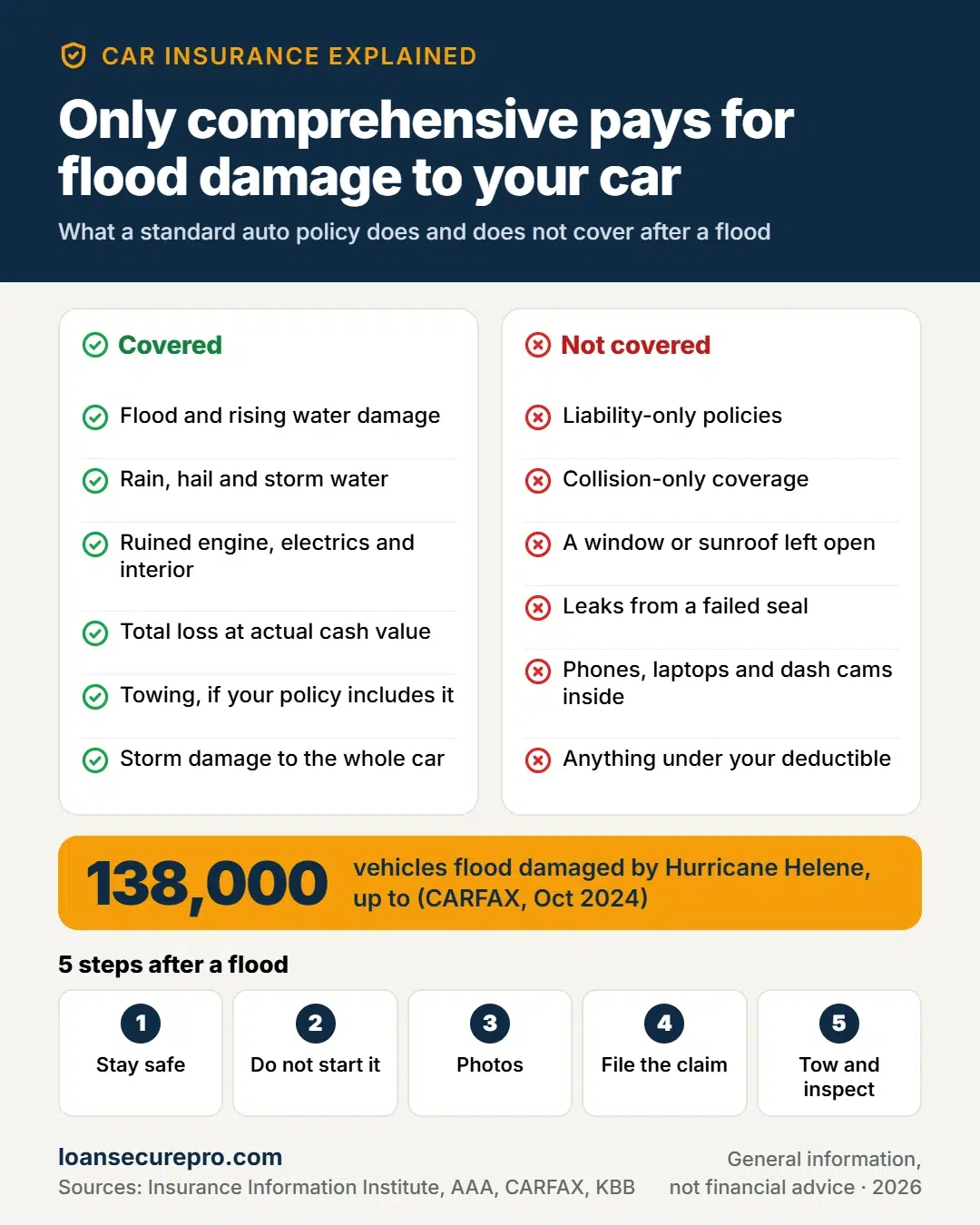
Yes, car insurance can cover flood damage, but only if you carry comprehensive coverage. Comprehensive pays for non-collision losses such as flood, hail, fire and falling trees, minus your deductible. Liability-only policies do not pay for your own car, and collision coverage applies to crashes, not water. If the flood ruins the car, the insurer usually pays its actual cash value, which is its market value just before the flood, not what you paid for it. A home flood policy typically excludes vehicles, so your auto policy is the one that counts.
In short: check your declarations page for a comprehensive line. If it is there, photograph the damage, do not start the engine, and call your insurer. Water in the cylinders can destroy an engine in seconds.
Many drivers only find out which coverages they bought after the water has already come in. A flooded car can also lose its value fast, so the first decisions you make in the next day matter.
The scale is large. CARFAX estimated on October 17, 2024 that up to 138,000 vehicles were flood damaged by Hurricane Helene alone, with Florida at 60,700 and South Carolina at 27,500.
This guide is for US drivers whose car has flooded or who want to know their protection first. It explains what comprehensive pays, what it excludes, how a total loss is calculated, the steps to take, and what to check if you buy a used car after a flood.
Key takeaways
- Comprehensive coverage is the part of a car policy that pays for flood damage, minus your deductible.
- Liability and collision coverage do not pay for flood damage to your own car.
- Do not start a flooded engine, because water in the cylinders can cause serious damage.
- A waterline on the dashboard often means a total loss in modern cars, because of the electronics.
- A total loss pays actual cash value, not the price of a new car, and your loan balance can be higher.
- A window left open or a leaking seal is usually excluded, and personal items inside are usually not covered.
- Flood insurance for a home or business typically excludes vehicles.
In this guide
- Which coverage pays for flood damage?
- What flood claims usually exclude
- Worked payouts: repair versus total loss
- When a flooded car is a total loss
- What to do after a flood, step by step
- What happens after you file
- Buying a used car after a flood
- Do and don’t with a flooded car
- Where state and insurer rules differ
- Honest limits of this guide
- When to talk to a professional
- Frequently asked questions
Which coverage pays for flood damage?
The Insurance Information Institute describes comprehensive as covering damage from an incident other than a collision, and it names “fire, flood, hail, falling rocks or trees, striking an animal and other hazards” among its examples.
That makes comprehensive the coverage to look for. National General adds that lenders and banks often require it when you finance or lease a car, so many drivers carry it without realizing what it does.
| Coverage | Pays for flood damage to your car? | Why |
|---|---|---|
| Comprehensive | Yes, minus the deductible | Covers non-collision events such as flood, hail and fire |
| Collision | No | Applies to crashes with another vehicle or object |
| Liability | No | Pays for harm you cause to others, not your own car |
| Home or business flood policy | Typically no | AAA notes flood insurance typically excludes vehicles |
| Liability-only policy | No | Without comprehensive, a flooded car is usually your own cost |
For a full list of events comprehensive handles, see our guide to what comprehensive car insurance covers. If the damage came from deliberate harm rather than water, our vandalism guide explains that separate path.
What flood claims usually exclude
Even with comprehensive, some water damage is not paid. AAA lists the main exclusions, and they come up often in disputed claims.
| Situation | Usually covered? | Notes |
|---|---|---|
| Floodwater from a storm or overflowing river | Yes, with comprehensive | Subject to your deductible |
| Rain through a window you left open | Usually no | Insurers treat it as negligence |
| Leak from a failed sunroof or door seal | Usually no | Treated as poor maintenance, not a covered event |
| Phones, laptops, dash cams, GPS inside the car | Usually no | May be covered by a homeowners or renters policy |
| Aftermarket parts you added | Depends on the policy | Ask whether custom equipment is listed on your policy |
Personal belongings are the surprise for many people. AAA says comprehensive typically does not include items such as GPS devices, dash cams, phones, tablets and laptops, which a homeowners or renters policy may cover instead.
The difference between a covered flood and an excluded leak often comes down to how the water got in and what you did beforehand. Photos taken before the storm, if you have them, help show the car’s condition.
Worked payouts: repair versus total loss
The deductible is the first thing subtracted from any comprehensive claim. If you want the mechanics, our guide to how car insurance deductibles work walks through them. Here are two floods with assumed numbers.
Case 2 is the trap. A total loss pays market value, and if you owe more than that you keep paying on a car you no longer have. National General warns that a common misconception is that the settlement will cover the cost of a new vehicle.
The dollar figures here are assumptions for the method. Your policy lists your real deductible, and the insurer sets actual cash value from a market valuation of your car’s year, mileage and condition.
When a flooded car is a total loss
An insurer declares a total loss when the cost of repair, cleaning and odor removal, plus other costs, exceeds a set share of the car’s value. The share differs by state and insurer, so there is no single number.
Kelley Blue Book notes that a waterline on the dashboard often signals a likely total loss in modern cars because of their sensitive electronics. Water that reaches wiring harnesses, control modules and infotainment systems can cause failures months later, which is why insurers are cautious.
| Water level | Typical damage | Likely outcome |
|---|---|---|
| Below the door sills | Brakes, undercarriage, some wiring | Often repairable |
| Over the floorboards | Carpets, seat rails, low modules | Repair or total loss, depending on cost |
| Up to the seats or dashboard | Electronics, airbag modules, interior | Total loss is common |
| Saltwater, any level | Corrosion, delayed electrical faults | Higher chance of total loss |
Hybrids and EVs. KBB warns that saltwater submersion may cause delayed battery fires in hybrids and electric vehicles. Do not open the hood if orange high-voltage cables or battery packs were submerged. Call trained technicians.
If the insurer totals the car and you disagree with the value, ask for the valuation report and send comparable listings for the same year, trim and mileage. You can also appeal to your state Department of Insurance.
What to do after a flood, step by step
The order matters. Safety comes first, and the biggest mistake is turning the key.
- Stay safe. KBB says not to wade into water deeper than your knees, and even ankle-deep fast water can knock you down. Leave the car until the water recedes.
- Do not start the engine. KBB advises leaving it off until a qualified mechanic inspects it. Water in the cylinders can cause serious damage if you crank it.
- Photograph everything. Take timestamped photos and video of the waterline inside and outside, the trunk, lights and engine bay, from several angles.
- List what was inside. Make a list of personal items and their value, since they may fall under a different policy.
- Call your insurer. Use the app or claims line, and record the claim number and adjuster’s name. Ask whether your policy includes towing.
- Disconnect the battery if told to. KBB suggests wearing dry gloves and disconnecting the 12-volt battery to reduce shorts, but follow your insurer’s instructions first.
- Start drying only if safe. Remove standing water with a wet and dry vacuum and open the doors and windows when weather allows.
- Have a mechanic inspect it. Expect fluids to be replaced and the electrical systems tested before any decision.
Documents checklist: photos and video with dates, claim number, adjuster contact, list of personal items, repair estimate, tow receipt, loan details and your policy number with the comprehensive deductible.

What happens after you file
After a large storm, many people in the same area file at once. Insurify notes that claims may take longer for that reason, so build in extra time.
| Stage | What happens | What you can do |
|---|---|---|
| Day 0-1 | You report the loss and get a claim number | Send photos and the list of damage right away |
| Days 1-7 | Car is towed and an adjuster inspects it | Ask for the inspection date in writing |
| Weeks 1-4 | Repair estimate or total-loss valuation | Review the valuation and compare it with local listings |
| After approval | Payment minus the deductible, sent to you or your lender | Confirm who is paid first if you have a loan |
If the claim is denied, ask for the reason in writing and the policy language the insurer relies on. Then appeal within the insurer and, if needed, to your state Department of Insurance.
Buying a used car after a flood
Flooded cars sometimes return to the market. CARFAX estimated up to 138,000 vehicles were flood damaged by Hurricane Helene, and up to 89,000 more had been water damaged earlier in 2024.
| State | Vehicles flood damaged by Helene (up to) |
|---|---|
| Florida | 60,700 |
| South Carolina | 27,500 |
| North Carolina | 22,900 |
| Georgia | 16,800 |
| Tennessee | 4,900 |
| Virginia | 4,900 |
CARFAX lists seven signs of a flood car:
- Damp carpets.
- A musty smell, possibly masked by air freshener.
- Loose, new, stained or mismatched upholstery or carpet.
- Rust around doors, under the dash, on pedals, or in hood and trunk latches.
- Mud or silt in the glove compartment or under the seats.
- Brittle wires under the dashboard.
- Fog or moisture in interior lights, exterior lights or the instrument panel.
Check the vehicle history report, and have a trusted mechanic inspect the car before you buy. A car with a clean-looking interior can still hide corrosion that shows up later.
Do and don’t with a flooded car
Do
- Photograph the waterline and damage before anything is moved
- Call your insurer the same day
- Keep the engine off until a mechanic inspects it
- Keep receipts for towing and drying
- Ask whether your policy includes towing and a rental
Don’t
- Turn the key to see if it starts
- Wade into deep or fast water to reach the car
- Open the hood on a submerged hybrid or EV
- Throw away damaged parts before the adjuster sees them
- Accept a total-loss value without checking comparable listings
Where state and insurer rules differ
Flood claims follow the same basic logic everywhere, but four details change from place to place.
Total-loss threshold. Each state sets how much repair cost, compared with the car’s value, makes a car a total loss. Some use a percentage and some use a formula, so the same flood can total a car in one state and not another.
Title branding. Many states mark a totaled or flood-damaged car on its title. A branded title lowers resale value, so ask what happens to the car if you keep it after a payout.
Deductible and rental. Comprehensive deductibles are set by your policy, and National General says they commonly range from $200 to $2,000. Rental reimbursement and towing are separate options on many policies.
Storm rules. Insurers often pause new or increased coverage when a named storm is approaching. Some states also set claim-handling deadlines after declared disasters, so ask your state Department of Insurance.
Honest limits of this guide
This guide explains how flood claims generally work. Your own policy, your state’s rules and your insurer’s practices control the details, including the deductible, what counts as a total loss and how quickly claims are paid.
The coverage rules come from the Insurance Information Institute, AAA, Kelley Blue Book and National General, none of which can see your policy. The vehicle counts are CARFAX estimates from October 2024 and are described as “up to”, not exact totals.
The dollar examples use assumed deductibles and values. We did not test any insurer’s claims process, and total-loss thresholds are set by each state, so we do not give one.
When to talk to a professional
Call your insurer’s claims line the same day, and ask a licensed agent if you are unsure whether you carry comprehensive. It takes a minute to confirm.
Talk to your state Department of Insurance if a clearly covered claim is denied without a written reason. Talk to your lender if the total-loss payment will not clear your loan, and ask them about gap coverage or deferral options.
Disclaimer: this article is general information, not insurance, legal or financial advice. Coverage depends on your policy, your state and your insurer. Confirm details with a licensed professional before relying on them.
Frequently asked questions
Does liability insurance cover flood damage?
No. Liability pays for injuries and property damage you cause to other people, so it does not pay for your own car in a flood. You need comprehensive coverage for that. If you carry liability only, the repair or replacement is usually your own cost.
Does collision coverage cover flood damage?
No. Collision applies to crashes with another vehicle or object, and floodwater is a non-collision event. Flood damage falls under comprehensive coverage instead. If a car is swept into something and crashes, the insurer may decide which coverage applies, so describe exactly what happened.
Will my rates go up after a flood claim?
Not necessarily. A flood is not your fault, and many insurers do not surcharge comprehensive claims as heavily as at-fault crashes, but practices vary by insurer and state. After a widespread disaster, rates in the area may rise. Ask your insurer how the claim will affect renewal.
Does insurance pay if I left my window open?
Usually not. AAA says damage from a window left open during a storm is typically excluded, because insurers treat it as negligence. If water entered through a failed seal, that is also usually excluded as poor maintenance. Flood water rising from outside is treated differently.
Are my belongings in the car covered?
Usually not by car insurance. AAA says comprehensive typically does not include items like phones, laptops, dash cams and GPS devices. A homeowners or renters policy may cover them. Make a list with values and photos, then ask your insurer which policy applies.
How much will I get for a flooded car that is totaled?
Usually its actual cash value just before the flood, minus your comprehensive deductible. That is market value based on year, mileage and condition, not the price of a new car. If you owe more than that, you still owe the difference unless you have gap coverage.
Can I drive a car after it has been in floodwater?
Not before a mechanic inspects it. KBB advises not starting a flooded engine, since water in the cylinders can cause serious damage. Electrical faults may appear later even if the car runs. For hybrids and EVs, wait for trained technicians before touching high-voltage parts.
Does flood insurance for my house cover my car?
Typically no. AAA notes that flood insurance typically excludes vehicles, along with ATVs, golf carts, motorcycles and watercraft. Cars are handled by comprehensive coverage on your auto policy. If you do not have comprehensive, a home flood policy will not fill the gap.
How long does a flood claim take to pay?
Simple claims can settle in a few weeks, but after a widespread storm it can take longer because many policyholders file at once. Delays also come from towing, inspections and valuation disputes. Keep your claim number handy, follow up in writing and ask for a target date.
How can I tell if a used car was flooded?
Look for damp carpets, a musty smell, mismatched upholstery, rust under the dash or on pedals, mud under the seats, brittle wires and moisture inside lights. Check the vehicle history report, then have an independent mechanic inspect it. Be cautious if the seller avoids questions.
The bottom line
Car insurance covers flood damage only through comprehensive coverage, and it pays minus your deductible. Liability and collision do not, and neither does a home flood policy. A total loss pays market value, so check whether your loan balance is higher.
Check your declarations page for comprehensive today. After a flood, stay safe, do not start the engine, photograph the waterline and call your insurer the same day.
Sources
- Insurance Information Institute: What is covered by a basic auto insurance policy? (accessed Oct 31, 2026)
- CARFAX: Up to 138,000 cars flood damaged by Hurricane Helene (Oct 17, 2024) (accessed Oct 31, 2026)
- AAA: Does car insurance cover floods and water damage? (accessed Oct 31, 2026)
- Kelley Blue Book: What to do if your car is flooded (accessed Oct 31, 2026)
- National General: Flood recovery, what is protected for my car? (accessed Oct 31, 2026)